Is October a Good Month to Visit New York City?
A direct, sourced answer on whether October is a good month to visit New York City, with real climate data, crowd and pricing context, and what is on.

October in New York City is the month when the humidity finally breaks and the parks start turning. The average high sits at 64.5 degrees Fahrenheit against an average low of 51.4, which means light layers by day and a real jacket after dark. It is also, according to the official NOAA climate normals for Central Park, wetter than almost any summer month, a fact that surprises most visitors packing for "crisp autumn" weather.
This page answers the question directly, then breaks down what October actually feels like on the ground: weather, crowds, costs, packing and what is happening across the city while you are there.
Is October a Good Month to Visit New York City?
Yes, October is one of the best months to visit New York City. Days average a high of 64.5 and a low of 51.4 degrees Fahrenheit, the summer humidity has gone, and fall color moves through Central Park through the month. The two honest caveats are rain, since October averages 4.38 inches of precipitation, and crowd peaks, since weekends around Halloween and school holidays are among the busiest of the autumn season.
The case for October rests on the climate record more than on postcard imagery. The NOAA 1991-2020 normals for Central Park put October's average high at 64.5 degrees, down from September's 76.2 but well above November's 54.0. That is walking weather, and New York is a city that rewards walking. The High Line, the Brooklyn Bridge promenade, Greenwich Village and Central Park's loops are all at their most comfortable in this band, warm enough for a long afternoon and cool enough that a museum stop feels like a break rather than an escape from heat.
The second argument is atmospheric rather than statistical. Fall color in Central Park typically builds through October, starting with the sugar maples and finishing near month's end. The park is free, open all day, and at its photographic best precisely when the tourist high season has passed. A morning loop from Bethesda Terrace toward the Ramble, then a subway ride downtown for lunch, is close to the ideal New York day, and October is the month that day exists.
The caveats deserve equal billing. October averages 4.38 inches of rain, only about a fifth of an inch behind July, the wettest month of the year at 4.60. The image of dry, golden autumn days is partly myth; you should pack for showers and plan at least one indoor day. And the calendar has busy spikes: the weeks around Halloween pull big crowds, and the city is generally livelier than in the quiet stretch of January and February.
If October is your month, the rest of this page covers the practical questions: what the weather really does, how busy it gets, what to pack, what things cost, and what is on.
What Is the Weather Really Like in New York in October?
October in New York averages a high of 64.5 and a low of 51.4 degrees Fahrenheit, with 4.38 inches of rain across the month and essentially no snow, just a 0.1 inch trace in the record. Early October feels like late summer's last stand, with highs nearer September's 76.2, while late October behaves more like November. Rain falls on more days than most visitors expect, so a packable rain layer matters more than heavy insulation.
The official numbers, read from the NOAA 1991-2020 climate normals for the Central Park station, give the full picture when you set October beside its neighbors:
| Month | Avg high | Avg low | Precipitation | Snowfall |
|---|---|---|---|---|
| September | 76.2°F | 62.3°F | 4.31 in | 0.0 in |
| October | 64.5°F | 51.4°F | 4.38 in | 0.1 in |
| November | 54.0°F | 42.0°F | 3.58 in | 0.5 in |
Two things jump out of that table. First, the temperature swing across October is large: the month starts closer to September and ends closer to November, so "what's the weather like in October" genuinely depends on which week you book. A visit in the first week can still hit the mid 70s; a visit in the last week can see evenings in the 40s. Second, October is wetter than September and only marginally behind July. The driest month of the New York year is February, at 3.19 inches, which inverts what most people assume about the calendar.
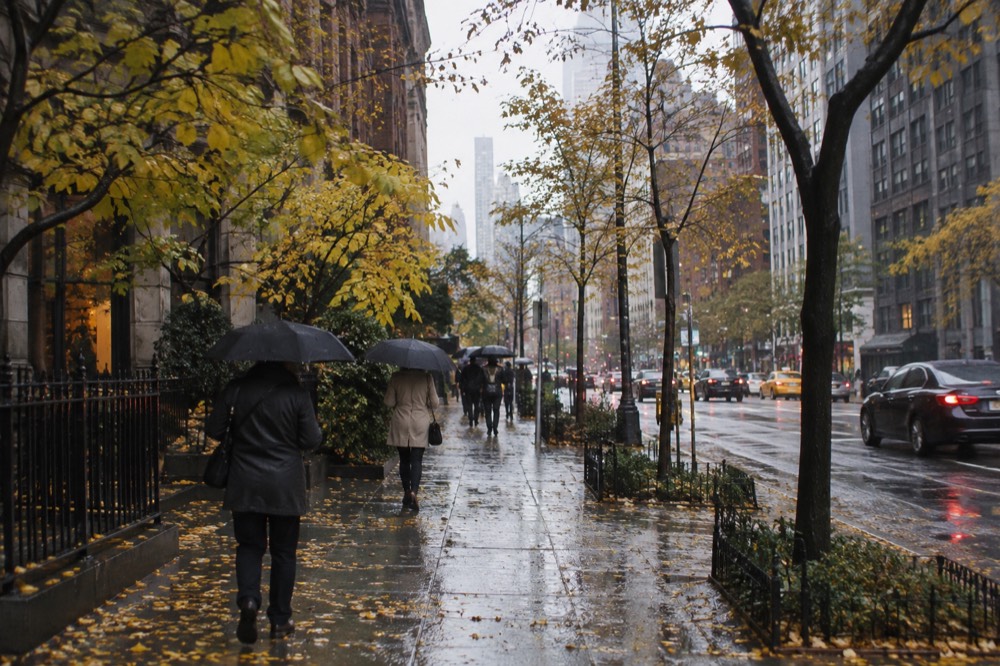
What that means for planning is simple. Layer everything. A shirt, a sweater and a light rain shell covers most October days, with a warmer coat if you are visiting in the back half of the month or planning evening time outdoors, like a sunset cruise on the harbor. Check the forecast close to your dates rather than trusting the averages, because the spread between an early-October and a late-October week is effectively a change of season.
One more practical note: the wind picks up on the water. If a harbor cruise or a ferry to the Statue of Liberty is on your list, the deck is noticeably colder than the street, and the rain risk is real enough that a hood beats an umbrella on a boat.
A pass decision fits naturally into October planning, because the month's itinerary, decks, museums and the ferry, is exactly the bundle the CityPASS was designed around. If you are still weighing it, the crowds section below explains which October bookings genuinely need to happen early and which can wait until you are in the city.
How Crowded Is New York in October?
October is a busy month, but the crowds are a different species from summer's: fewer international tour groups, more weekend visitors, and locals back in full swing after Labor Day. The busiest stretches are weekends, the school holiday around mid-month, and the run-up to Halloween. Lines at the major decks and the Statue of Liberty ferry are long but manageable if you book timed entry in advance, which in October is a genuine necessity rather than a nicety.
The city's overall visitor volume gives the backdrop: New York City welcomed 65 million visitors in 2025, up slightly on the year before, and autumn is one of the two peak windows alongside early summer. October's crowds concentrate around three things: observation decks, the Statue of Liberty ferry, and the marquee museums. All three run timed or capacity-limited entry, which means the crowding problem is mostly a booking problem. A traveler who reserves deck slots and ferry tickets ahead travels through October easily; one who shows up at the box office at noon on a Saturday does not.
The subway context is worth knowing, too, because it shapes how the city feels. Per MTA data, 2025 subway ridership recovered to about 75 percent of 2019 overall, but the split is the interesting part: weekday ridership sits at only 73 percent of pre-pandemic levels while weekend ridership is at 88 percent. In other words, the trains you will ride as a visitor, the weekend and evening trains, are the full ones. Midday weekdays are the softest window for museums and popular streets, and that is when locals are at work.
If avoiding crowds is a priority, the levers are: go midweek if you can, start mornings early, and pick the less obvious but equally October-appropriate stops, like the Brooklyn waterfront or a neighborhood walk in Greenwich Village, over the single most famous vantage points at peak hours.
What Should You Pack for New York in October?
Pack for two climates in one bag: daytime temperatures in the 60s and evenings that can drop into the 40s by late month. The core kit is a sweater or fleece, a light rain shell, comfortable waterproof-adjacent walking shoes, and one warmer layer for evenings and the waterfront. Umbrellas are sold on every corner when it rains, but a hooded jacket handles the wind and the boat decks better. Sunglasses still earn their place.
The layering logic follows the numbers. With a 64.5 average high and a 51.4 average low, the daily swing is about 13 degrees, and it is larger in the second half of the month. A morning that starts at 50 can still reach 65 by mid-afternoon, then fall back fast after sunset. Three thin layers beat one heavy coat, because you will shed and re-add them all day. More of these guides are collected on New York City Travel Guide.
Footwear is the underrated decision. October's 4.38 inches of rain means wet pavement is likely at some point in your trip, and New York walking distances are long: a day that strings together a museum, a park and a neighborhood easily covers five miles. Broken-in shoes with real tread, plus a pair that can survive a puddle, will do more for your trip than any single "attraction" purchase.
Beyond that, the standard New York kit applies: a battery pack for photos and transit apps, a tap-to-pay card or phone for the subway, and a bag light enough to carry through museums. If Halloween festivities are on your agenda, note that costumes and crowds go together; comfortable shoes matter twice as much on that night.
Is October Expensive Compared to Other Months?
October sits in the upper-middle band of New York pricing: cheaper than the December holiday peak, more expensive than the January-February trough. Attraction prices are published and stable: observation decks start from roughly the $34-$44 range, the Metropolitan Museum of Art charges a fixed $30 for out-of-state adults, and a five-attraction CityPASS at $149 covers the classic circuit over nine days.
Hotel rates are date-specific, so check live listings rather than trusting guide figures.
The deck prices, from the operators' own published starting rates, give a real comparison for the most popular paid stops:
| Attraction | Published adult starting price | Notes |
|---|---|---|
| Edge at Hudson Yards | from $34-$45 | dynamic timed pricing, plus processing fee |
| Top of the Rock | from $42 | dynamic timed pricing |
| SUMMIT One Vanderbilt | from $44 | 13+; youth 6-12 from $38, plus per-order fee |
| Empire State Building (86th floor) | from $44 | plus $5 booking charge per transaction |
| One World Observatory | from $39-$44 | dynamic timed pricing, plus fee and tax |
Those are starting prices for the cheapest slots, and demand pricing means October weekends push the actual price up. Two structural savings matter more than hunting discounts. First, the New York CityPASS: $149 adult, $129 child, valid for nine consecutive days, covering your choice of five attractions from an eleven-attraction menu. CityPASS's own math puts the combined box-office value of a typical five-pick adult selection at $307.04, a claimed saving of $158.04, or 51 percent. It only pays off if you genuinely use all five, but an October trip hitting the Empire State Building, Top of the Rock, the Statue of Liberty ferry and two museums is exactly the itinerary the pass was built for. You can compare it against the alternatives in our New York City pass comparison.
Second, the fixed-price stops are fixed: the Met is $30 for adults no matter the season, and one ticket covers both Met Fifth Avenue and The Met Cloisters on the same day, which most guides never mention. Broadway is the wildcard: October is a strong theatre month, and the TKTS booths sell same-day tickets at up to 50 percent off face value with an $8 per-ticket service fee. The booths operate from Times Square and Lincoln Center, and live inventory shows in the TKTS app.
Getting around is cheap and flat year-round: the subway is $3.00 a ride with contactless payment, and the $35 weekly OMNY fare cap applies automatically after enough taps on the same card or device. There is no 7-day unlimited pass to buy any more; that product was retired with the MetroCard. Full fare mechanics are in our guide to the NYC subway and OMNY.
What Is on in New York in October?
October's calendar is anchored by Halloween, which the city takes seriously, from house decorations to the big nightlife push in Greenwich Village and across Brooklyn, plus peak fall foliage in the parks and the last comfortable weekends for day trips up the Hudson. Sports are in full season and Broadway is running its fall slate. Nothing in October requires booking months ahead except the Statue of Liberty crown, which sells out far in advance whenever you travel.
Fall color is the headline. Central Park's maples, oaks and sweetgums turn progressively through the month, and the color extends beyond Manhattan: the Hudson Valley day-trip belt, reachable by train or coach, is at its best precisely in October. If foliage is a priority for your trip, our Hudson Valley from NYC guide covers the reachable options without a car, which is the honest way to do it, since a rental car is more burden than benefit inside the city itself.
Halloween is the cultural peak. The weeks around it bring decorated storefronts, costume nightlife, and heavy crowds in the Village and in party-heavy Brooklyn neighborhoods. If you are traveling with children, the pumpkin-and-costume programming across the city makes late October a genuinely family-friendly window; our NYC with kids guide has the year-round context.
For the view-and-landmark itinerary, October's clear, low-humidity days are among the best of the year from the observation decks. SUMMIT One Vanderbilt's mirror rooms in particular play well with autumn light, and timed entry keeps the flow moving:
The one booking that genuinely needs early action is the Statue of Liberty crown. Crown reserve tickets cost only thirty cents more than the standard grounds ticket, $26.30 versus $26.00, but supply is severely limited, tickets are name-bearing with photo ID checks, and they are reported to sell out months ahead. If the crown is on your October list, book it as soon as your dates are fixed, through Statue City Cruises, the only operator authorized to land at the islands.
Common Questions About Visiting New York in October
October visitors ask the same five things: whether it is cold, whether it rains, when the leaves peak, whether they need advance bookings, and how it compares to November. The short answers: it is mild, it rains more than you think, color builds through the month, timed entry for decks and the ferry is effectively required, and October beats November on temperature while November beats it on crowds.
is october a good month to visit new york city?
Yes. October combines mild temperatures, an average high of 64.5 degrees, fall color in the parks, and a full calendar of events. The trade-offs are meaningful rain, averaging 4.38 inches for the month, and busy weekends, especially around Halloween and school holidays.
Is October cold in New York City?
Not by local standards. Days average a high of 64.5 and nights a low of 51.4 degrees Fahrenheit. Early October can still reach the mid 70s, while late October evenings can drop into the 40s, so pack layers rather than a single heavy coat.
Does it rain a lot in New York in October?
More than most visitors expect. October averages 4.38 inches of precipitation per the NOAA 1991-2020 Central Park normals, slightly wetter than September and just behind July, the wettest month. Bring a hooded rain layer and keep one indoor backup plan per day.
When do the leaves change in Central Park?
Color builds progressively through October and is typically at its strongest late in the month, with different species turning at different times. There is no single published peak date, so plan your park time across your trip rather than betting on one day.
Do I need to book attractions in advance for October?
Yes for anything timed or capacity-limited: observation decks, the Statue of Liberty ferry, and the major museums. The Statue of Liberty crown in particular sells out months ahead, and it must be booked through Statue City Cruises, the only operator authorized to land at the islands.
Is October or November better for visiting New York?
October is warmer, with an average high of 64.5 against November's 54.0, and has the fuller events calendar. November is quieter and has the Macy's Thanksgiving Day Parade at month's end. For first-time visitors prioritizing outdoor sightseeing, October is the stronger pick.
The bottom line for an October trip: book the timed-entry stops early, pack a rain shell beside the sweater, and give at least one morning to Central Park while the color is up. The month earns its reputation, rain and all.