Is It Safe to Drink Tap Water in New York?
A direct, sourced answer on whether New York City tap water is safe to drink, where it comes from, how it tastes, and when a filter or bottled water makes sense for visitors.
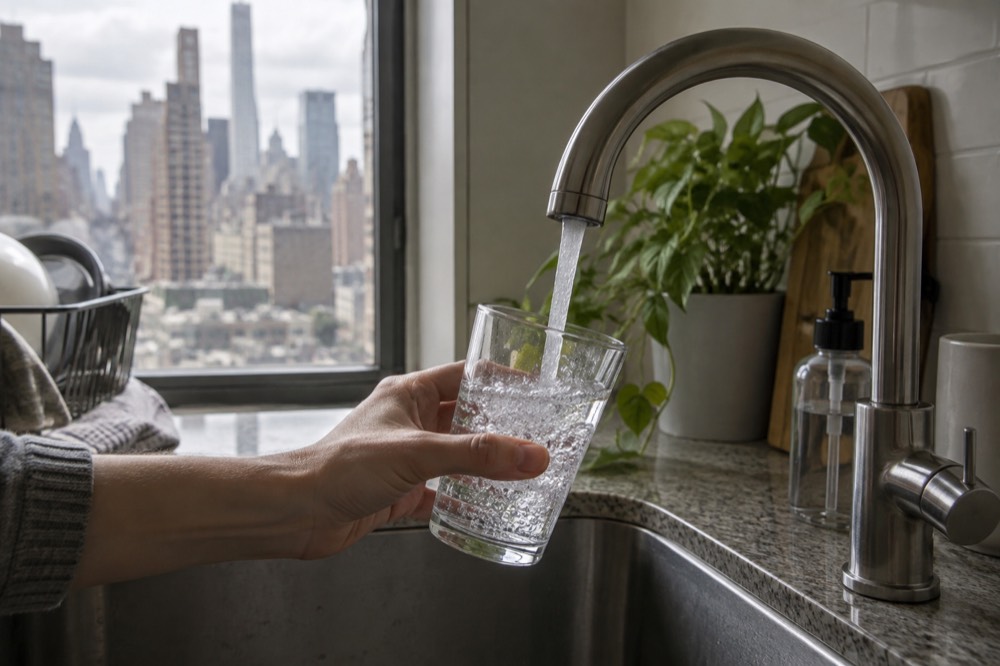
New York is one of the few large American cities where the tap water is not just safe but genuinely celebrated. Bagel bakers and pizza makers credit it, locals refill bottles from public fountains without a second thought, and the city's own water department publishes the results of hundreds of thousands of tests a year. For a visitor standing in a hotel bathroom wondering whether to fill a glass, the short answer is straightforward: yes, drink it. The longer answer, which this page gives in full, covers where the water comes from, why it tastes different from what you may be used to, and the handful of edge cases where a filter or a bottle is the better call.
Is It Safe to Drink Tap Water in New York?
Yes, tap water in New York City is safe to drink. The supply is tested continuously from protected upstate reservoirs to street-level taps across the five boroughs, and it meets federal and state drinking water standards. Millions of residents drink it daily and restaurants serve it by default. Problems that do appear are almost always building plumbing, not the city supply, and they are visible at the faucet.
The water arrives from protected reservoir systems north of the city, travels through tunnels that have supplied New York for generations, and is disinfected before distribution. The city's Department of Environmental Protection runs one of the largest routine monitoring programs of any water system in the country, sampling at the source and at taps across the boroughs. Results are published, not hidden. If something ever went wrong at a level that mattered, a boil-water advisory would be issued, and there is no such advisory in force.
What trips visitors up is rarely the water itself. It is the building. New York has a great deal of old housing stock, and in some older buildings the internal plumbing, not the municipal supply, is what gives water a metallic edge or a slight color when a faucet has sat unused overnight. The fix is local and free: run the tap until the water runs cold and clear, usually thirty seconds to a couple of minutes, then fill your glass. That flushes water that has been sitting in the building's pipes.
One useful mental model: the water in the street main is excellent, and most of the risk between that main and your glass is plumbing you can see with your own eyes. If a hotel faucet runs rusty, if a glass smells like a swimming pool, or if a water fountain looks badly maintained, trust the signal and use a different source. Those are building conditions, and they are rare enough that most visitors never encounter them.
Where Does New York City Tap Water Come From?
New York's drinking water comes from a network of protected reservoirs and lakes in watersheds north and west of the city, some more than a hundred miles away in the Catskill, Delaware and Croton systems. Gravity moves the water through aqueducts toward the city, and it is disinfected and, in one part of the system, filtered before delivery. Because the upstate watersheds are protected rather than heavily developed, the source water starts clean, which is the foundation of its quality.
This is the part of the story that surprises people. New York does not draw its drinking water from the Hudson River or from anything near the city itself. The supply is collected in rural, closely guarded watershed areas upstate, where the city owns land and regulates activity around the reservoirs precisely so the water needs minimal treatment. It is one of the reasons the water is soft compared with many American cities: it picks up few dissolved minerals on its way through granite and forest rather than through limestone.
Soft water is also the secret behind the local food folklore. Bagels, pizza dough and bread are all affected by water chemistry, and bakers in New York have long argued that the low-mineral water is part of what makes their crusts behave the way they do. Whether that is chemistry or romance is debatable, but the chemistry part is real: soft water interacts differently with flour and with yeast. Some out-of-state bagel shops have gone as far as replicating New York-style water profiles to chase the result.
For a visitor, none of this requires action. It simply explains why the water tastes the way it does and why the city is confident in it. The same watershed system supplies millions of people a day across the five boroughs, and it has done so through heat waves, blackouts and storms, with treatment standards that are enforced by federal law.
If you want to see the scale of the region your drinking water comes from, the boat is a good place to start. The Complete Manhattan Island Cruise circles the whole island, and the harbor it crosses is the same body of water the aqueducts tunnel under and around on their way south. Check availability on the operator's live listing if a two-and-a-half-hour loop around Manhattan fits your plans.
Why Does New York Tap Water Taste Different?
New York's water is soft, meaning it carries few dissolved minerals like calcium and magnesium, and it is disinfected with chloramine rather than heavy chlorine dosing, which gives it a cleaner, less chemical flavor than the tap water in many other American cities. Taste is subjective and visitors from hard-water regions often notice the difference immediately, sometimes favorably, sometimes not. The taste is a chemistry signature, not a sign of contamination.
Visitors from the Midwest or from parts of Europe with hard, mineral-rich water often say New York water tastes flat or even slightly sweet. That is soft water doing exactly what soft water does. There is nothing wrong with it. Conversely, visitors used to mountain spring water sometimes pick up the faint chloramine note and find it off-putting, the same way they might in any treated municipal system in the United States.
A few practical taste fixes work if the flavor bothers you:
| Situation | Likely cause | What to do |
|---|---|---|
| Water tastes metallic from a hotel faucet | Building pipes, water sat overnight | Run the tap until cold, then fill |
| Chlorine-like smell from the glass | Standard disinfectant residual | Refrigerate the water in an open pitcher for an hour, or use a carbon filter bottle |
| Cloudy or milky look that clears from the bottom up | Trapped air in the water | Harmless, let the glass stand for a minute |
| Slight brown or yellow tint | Old building plumbing or disturbed street main | Run the tap until clear, avoid drinking if it does not clear |
| Flat, sweet taste compared with home | Soft water, low mineral content | Nothing, this is normal for New York |
None of those rows describes a health hazard. They describe aesthetics and plumbing. The cloudy glass in particular worries people unnecessarily: air bubbles from the tap make water look milky, and the fact that it clears from the bottom of the glass upward is the tell that it is air, not sediment.
Should You Use a Water Filter in New York?
Most visitors do not need a filter in New York, because the municipal water meets drinking water standards at the point of supply. A filter makes sense if you dislike the disinfectant taste, if your building's plumbing is visibly old, or if you carry one for medical reasons. In those cases a simple carbon filter bottle or pitcher is enough. It is a preference, not a necessity.
The honest framing is about margins, not danger. A carbon filter removes taste and odor compounds and improves the aesthetic experience. It is not a medical device, and using one in New York is a preference rather than a necessity. Travelers who already carry a filter bottle for the plane and the gym should simply keep using it here. There is no reason to buy a special product for New York specifically.
The one group worth a direct word: people with severely compromised immune systems sometimes receive general advice from their doctors about tap water everywhere, not just in New York. If that applies to you, follow the medical guidance you have been given, which usually means boiled or filtered water regardless of the city. New York's water is safe by public health standards, but individual medical circumstances can call for extra caution anywhere, and this page does not override a physician.
For everyone else, the filter question is purely about taste. If the hotel water tastes fine to you, drink it. If it does not, a filter pitcher from any pharmacy or grocery store in the city costs a few dollars and solves the flavor without generating a pile of plastic bottles. One note on hotel kettles and coffee machines: they draw the same tap water, so if the water is safe at the bathroom sink it is safe in your morning coffee. Descale complaints about hotel coffee are almost always about the machine, not the water.
Can You Drink from Public Fountains in New York?
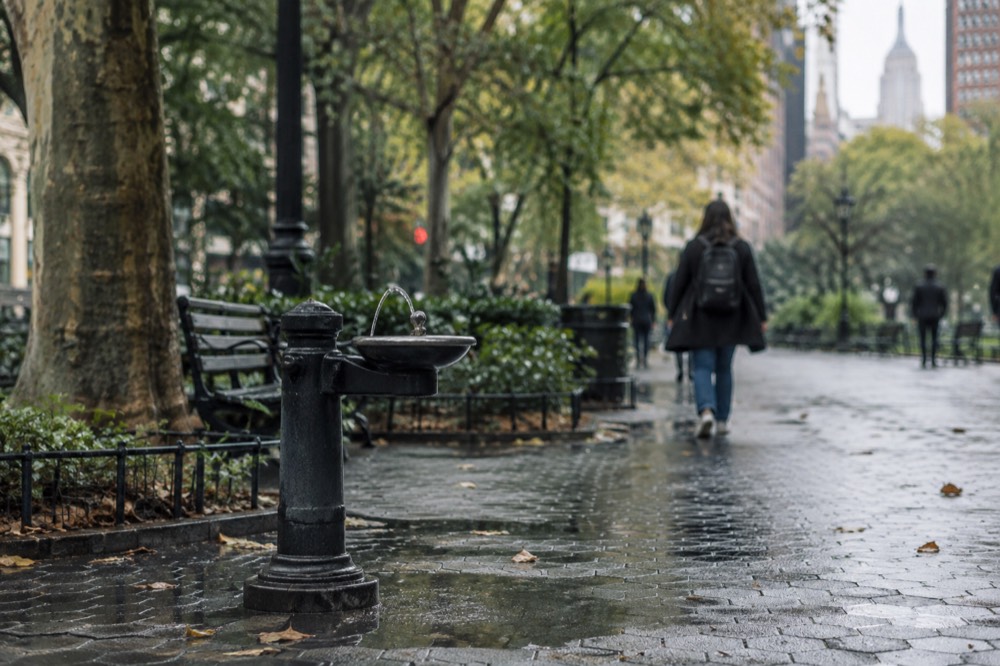
Yes, public drinking fountains in New York parks, playgrounds and transit hubs are safe to use, since they draw on the same treated municipal supply as household taps. Their condition varies with maintenance, so a fountain that is visibly dirty, cracked or stagnant is a fountain to skip, but a clean, running fountain is a perfectly good place to refill a bottle. Central Park, Prospect Park and most large parks have working fountains, though some are shut off in winter.
Fountains are seasonal in a way taps are not. From late fall through early spring many park fountains are winterized and shut off to prevent freeze damage, so a February visitor may find fewer working fountains than a July one. In summer the fountains run, and on hot days they are genuinely useful. Carrying a refillable bottle is the standard local move, and it is easy to top up in parks, in most museum lobbies and at water stations in major attractions.
Museums deserve a specific mention. The Metropolitan Museum of Art, the American Museum of Natural History and MoMA all have fountains or water bottle filling stations accessible with admission, and museum cafes will usually hand over a cup of tap water or ice water on request. On a long gallery day that saves both money and a walk. The same applies at observation decks: there is rarely a free water source at the top, so fill up before you ride.
Restaurants are the easiest case of all. By convention, most New York restaurants will bring you a carafe or glass of tap water for free when you sit down, and asking for "tap water, please" is completely normal, not a budget tell. Nobody will blink. If you want bottled, you will pay for it, and in many places it costs more than you expect. Street food carts and delis are the same: a request for a cup of water at a deli counter is routine, and most will fill one without charge, though on a scorching afternoon a small tip jar may be sitting there.
Is New York Tap Water Better Than Bottled Water?
For a visitor in New York, tap water is the better choice on almost every measure that matters: it costs nothing, it is tested more rigorously than most bottled brands, it produces no plastic waste, and it does not need to be hauled across the city. Bottled water in New York is overwhelmingly repackaged municipal or spring water sold at a markup. Drink tap unless a specific faucet gives you a reason not to.
The economics are stark at tourist scale. A family of four buying bottled water at Midtown prices across a week of sightseeing spends a meaningful amount of money on something that flows free from every hotel bathroom. That money is better spent on a show, a meal or a ticket. Visitors watching the overall budget can find the full picture in how much a trip to NYC costs, and skipping bottled water is one of the easiest line items to cut.
The environmental argument is not abstract here either. New York's curbside recycling exists, but the honest local norm is to avoid the single-use bottle in the first place. A refillable bottle carried from home, or a cheap one bought at any Duane Reade or CVS, covers the whole trip. Airport security is the one friction point: arrive with the bottle empty and fill it after the checkpoint, which is easy at JFK, LaGuardia and Newark once you are through.
There is one place where the water question intersects with sightseeing logistics, and it is worth planning rather than improvising. The official ferry to the Statue of Liberty and Ellis Island is a half-day outing in the open air, and while the boats have facilities, the queues and the sun make a carried bottle worthwhile. If that outing is on your list, the Statue of Liberty tickets guide covers the ferry tiers and what each one includes.
The official Statue City Cruises ferry is the only operator authorized to land at Liberty Island and Ellis Island, and the round trip plus both island museums is all in the ticket. Check availability on the operator's live listing before your date, because sailings fill on peak summer days when the harbor is at its busiest.
Common Questions About Drinking Tap Water in New York
The questions visitors ask most are variations on the same worry: is the water safe, does it taste strange, and is bottled necessary. The answers are short, and they all point the same direction. New York tap water is safe and closely monitored, the soft-water taste is normal rather than a defect, filters are a preference rather than a requirement, and restaurants serve tap water free on request. Only building-level plumbing problems, not the city supply, ever complicate the picture, and those are visible at the faucet.
Is it safe to drink tap water in New York?
Yes. New York City tap water is safe to drink and meets federal and state drinking water standards, with continuous testing from the upstate reservoirs to street-level taps. Millions of residents drink it daily, and restaurants serve it by default. Run the faucet briefly in older buildings if the water has sat overnight, and skip any individual fixture that looks dirty or runs discolored.
Does New York tap water taste bad?
Taste is personal. New York's water is soft and lightly disinfected, so visitors used to mineral-heavy water often find it flat or slightly sweet, while others find it cleaner tasting than their water at home. Neither reaction indicates a problem. A carbon filter bottle or a night in the fridge removes most of the disinfectant note if it bothers you.
Is the ice in New York safe?
Yes. Ice served in restaurants, bars and hotels is made from the same treated municipal water, and commercial ice machines are subject to health department inspection like the rest of the kitchen. There is no reason to ask for drinks without ice in New York.
Can I drink the tap water in my hotel?
In almost every case, yes. The municipal supply is the same one feeding every building in the city. In older buildings, internal plumbing can add a metallic taste or a brief tint when a faucet has not been used in hours, so run the water until it is cold and clear before filling a glass. If a faucet runs persistently rusty or smells strongly, use a different fixture and mention it to the front desk.
Is New York tap water safe for babies and pregnant visitors?
By public health standards, yes, and it is used for infant formula by families across the city every day. Pregnant visitors and parents of newborns who have received specific medical advice about tap water should follow that advice as they would anywhere. For everyone else, New York tap water needs no special precaution.
Do I need to buy bottled water in New York?
No. Bottled water in New York is largely a convenience product sold at a steep markup, and skipping it is one of the easiest ways to trim a trip budget. Carry a refillable bottle, fill it at the hotel and at park fountains, and ask for tap water in restaurants, where it is served free on request as standard practice.
The practical close is this: fill your bottle at the hotel, drink freely across the city, and spend the money you would have spent on bottled water on something you will actually remember. For everything else worth planning around water and beyond, the New York City Travel Guide covers the full trip, and NYC travel tips collects the habits that make a first visit run smoothly.