Dumbo Brooklyn: What the Neighborhood Is Like, and Who It Suits
Dumbo is a small waterfront corner of Brooklyn with outsized fame: one photography intersection, two bridges, a carousel in a glass box, and cobbles that hurt in the wrong shoes. Here is what it is actually like, hour by hour, and whether it earns a spot in your trip.
Short answer
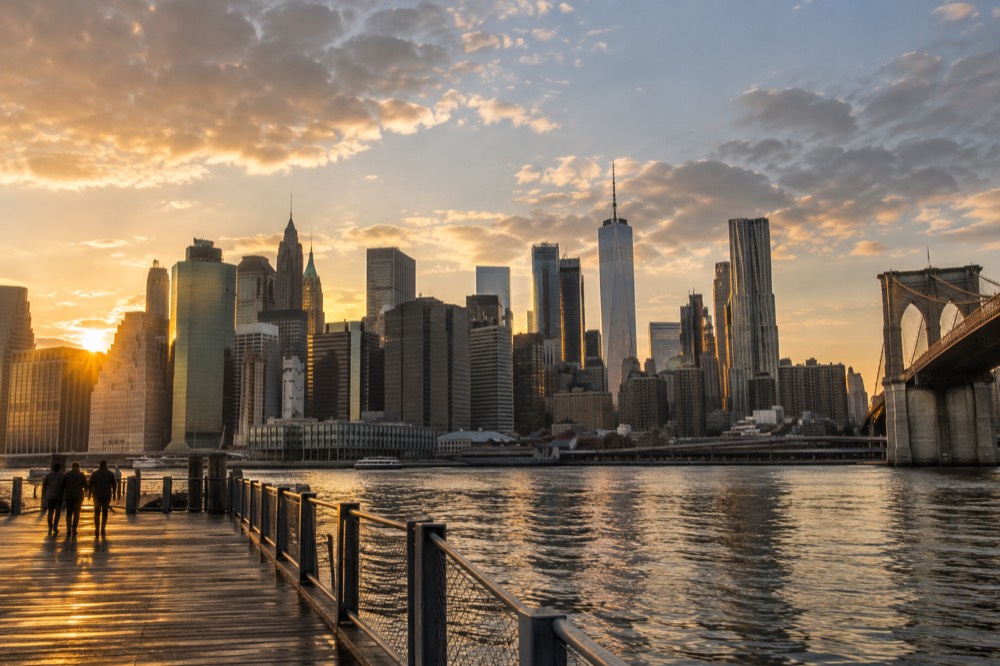
Dumbo is a compact, expensive, extremely photogenic waterfront neighborhood under the Brooklyn and Manhattan Bridges, best visited on a morning walk across the Brooklyn Bridge followed by a few hours of eating, park time and skyline photos. It suits photographers, families and anyone who wants the classic Manhattan skyline view, and it rewards an early start because the photo spots fill by late morning.
Dumbo sits on roughly a dozen blocks of Brooklyn waterfront, tucked between the Brooklyn Bridge and the Manhattan Bridge, and its name is literal: Down Under the Manhattan Bridge Overpass. The neighborhood is tiny. You can walk its full length in fifteen minutes, which is part of the problem, because a large share of New York's visitors now walks across the Brooklyn Bridge and empties directly into it. According to this site's reporting on how the area works, the practical questions are simple: when to come, what the photo spots actually cost you in time, and whether Dumbo deserves a full day or a two-hour stop. It deserves the two hours unless you plan to eat slowly, and it deserves them in the morning.
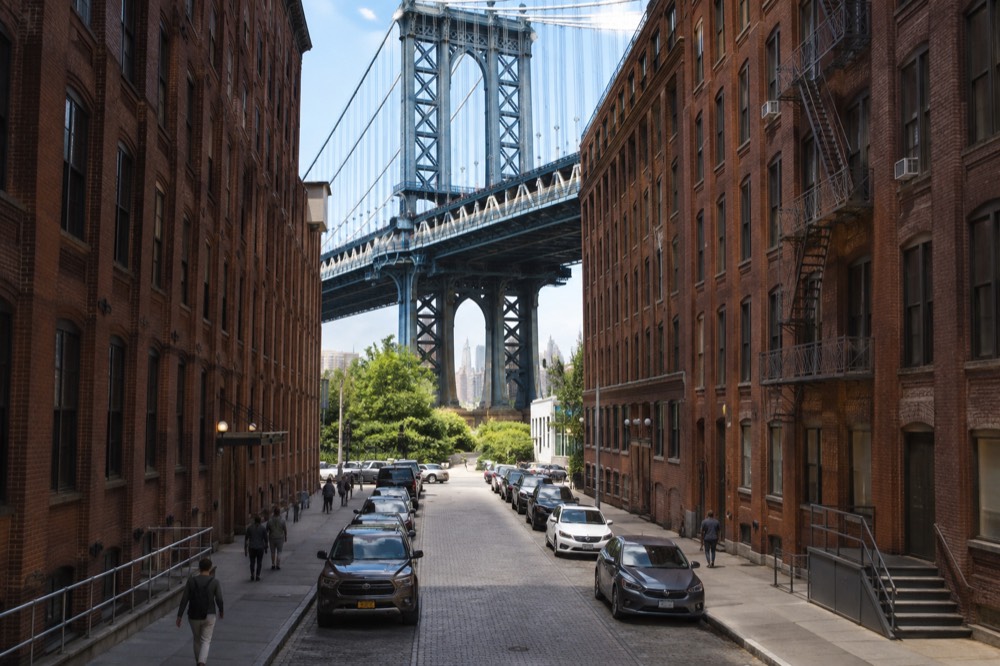
The classic payoff is the view. From Washington Street, the Empire State Building lines up neatly inside the arch frame of the Manhattan Bridge, with cobblestones and a converted coffee warehouse in the foreground. It is one of the most photographed corners of New York, and it is free. What follows is a full breakdown of the neighborhood: getting there, the sights, the food, the timing, and the tours that cover Dumbo better than you can cover it alone.
What Is Dumbo Brooklyn Known For?
Dumbo is known for the Washington Street photo, where the Manhattan Bridge arch frames the Empire State Building above cobblestones; for the Brooklyn Bridge promenade that delivers most visitors into it; and for its blocks of converted brick warehouses now holding tech offices, galleries and apartments. Jane's Carousel in its glass waterfront pavilion and Brooklyn Bridge Park along the shore complete the set. A dozen blocks carry an outsized share of New York's postcard imagery.
The name is an acronym, Down Under the Manhattan Bridge Overpass, coined back when the area was factories and empty lofts rather than boutiques. The industrial bones survived: the streets are still cobblestone, the buildings are still brick warehouses with big arched windows, and the two bridges still pass overhead close enough to feel. What changed is the use. The lofts filled with residents and companies, the waterfront became Brooklyn Bridge Park, and the galleries and food followed the foot traffic.
For a visitor, that history matters mainly as texture. Dumbo is not a museum piece like a preserved district, it is a working neighborhood that happens to be unusually scenic, and it behaves like one. Weekday mornings are calm, local, and slightly sleepy. Weekend afternoons are dense with camera phones around Washington Street. The bridges and the skyline stay the same; the crowd level is the variable you can control.
Is Dumbo Worth Visiting, or Just a Photo Stop?
Dumbo is worth visiting, but calibrate expectations: the sights themselves, the famous intersection, the carousel and the parks, take about two unhurried hours. What turns it into a half day is the combination with the Brooklyn Bridge walk, Brooklyn Bridge Park and a proper meal. Treat it as the Brooklyn side of a bridge crossing rather than a standalone destination, and it earns its place on a first trip.
The honest case for it: no other spot in New York gives you this specific combination. The Manhattan Bridge overhead, the Brooklyn Bridge a few blocks south, the East River in front, and Lower Manhattan's towers stacked across the water, all within a short, flat walk. The parks along the shore have lawns, pebble beaches and benches that face the skyline, and they are genuinely pleasant places to sit, not just backdrop.
The honest case against: it is crowded, it is expensive by neighborhood standards, and several of its best-known attractions are small. The photo intersection is an intersection. The carousel is a carousel. If you arrive at 2pm on a Saturday expecting solitude, you will find a queue for the sidewalk view.
A free walking tour is one way to get more from the stop. The Brooklyn Bridge, Brooklyn Heights and Dumbo Tour on GuruWalk covers the crossing, the promenade and the waterfront blocks with a guide who explains how these blocks were saved from demolition, and the price is whatever tip you decide at the end. For visitors who prefer a paid, ticketed option with a set schedule, a Brooklyn Bridge and Dumbo guided walk runs about two hours and ends near the subway back to Manhattan.
How Do You Get to Dumbo from Manhattan?
The two best routes are the walk across the Brooklyn Bridge, roughly 30 to 40 minutes at sightseeing pace, which descends directly into Dumbo at the Brooklyn end, or the subway: the F train to York Street lands in the heart of the neighborhood, and the A or C to High Street leaves a ten-minute walk with park views. The ferry also stops at the northern edge of Brooklyn Bridge Park.
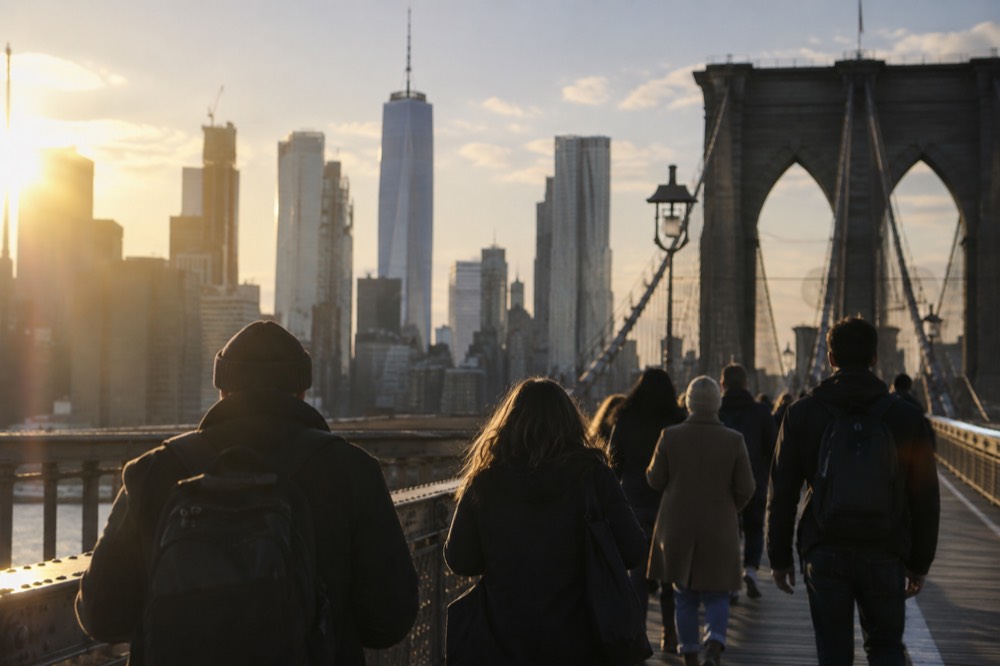
The walk is the classic move and the one most first-timers should take: cross the bridge eastbound from Manhattan, so the skyline stays in front of you the entire way, then descend into Dumbo and continue through the park. Note that the promenade gets tight, and bike lanes are separate; stay in the pedestrian lane.
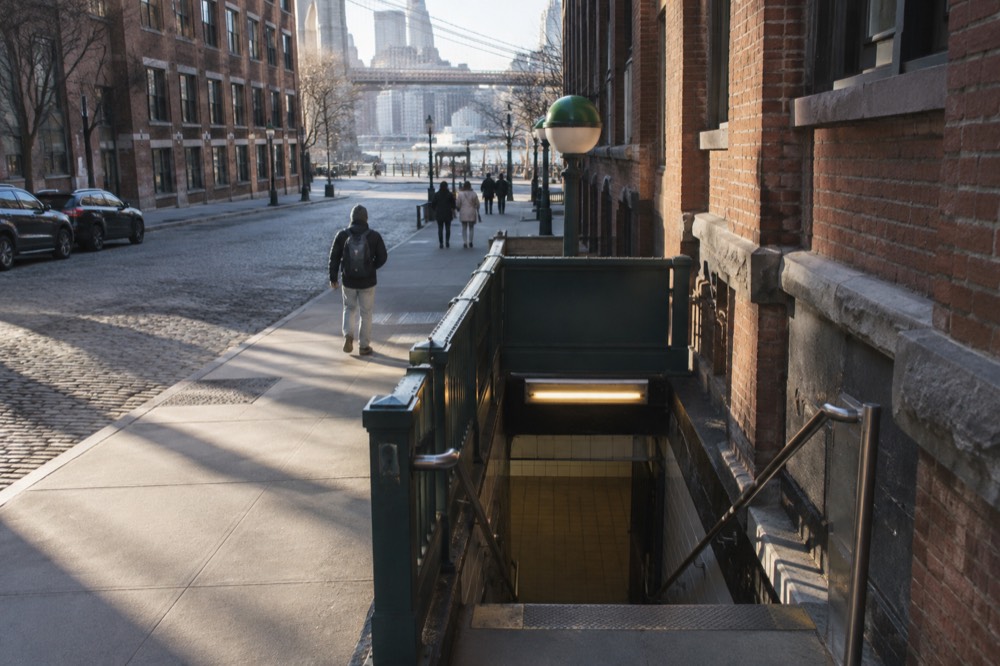
For the subway, tap in with OMNY. A single ride is $3.00, and there is no pass to buy any more: the MetroCard was retired as of 1 January 2026, and the weekly value now comes from an automatic $35 fare cap that applies when you tap the same card or device for every ride. If you are spending several days in the city, that cap quietly handles itself, per this site's guide to the NYC subway.
The ferry deserves a mention even though it costs more than the train. The NYC Ferry system's stops in the area put you on the water with the skyline sliding past, and the ride is short enough to be a pleasure rather than a time commitment. This site's NYC ferry guide covers routes, fares and how the system works.
Getting back to Manhattan is the same set of choices in reverse. The York Street F train is the fastest return to Midtown, and the bridge walk back at sunset is the most photogenic, with the caveat that the promenade is busy in both directions at that hour.
Where Are the Best Photo Spots in Dumbo?
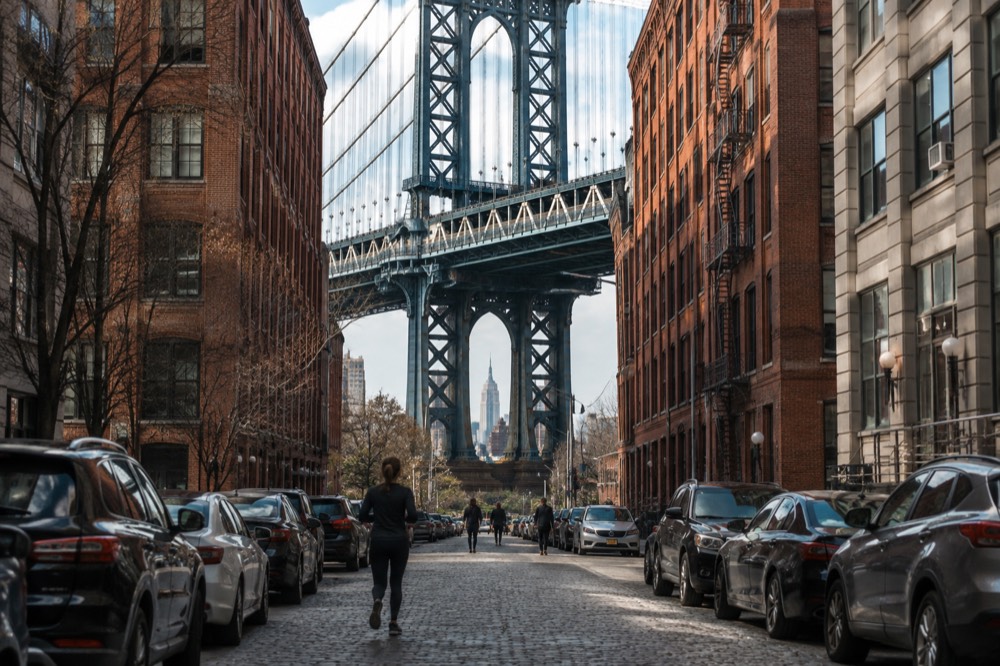
The most famous view is the Washington Street intersection, where the Empire State Building sits framed inside the Manhattan Bridge's arch above cobblestones; shoot from mid-street looking northeast. After that come the Brooklyn Bridge Park piers for the skyline panorama, Pebble Beach for the low water-level shot of the Brooklyn Bridge, and the Main Street Park lawn with the bridge rising directly overhead. All of them are free and all are best before 10am.
Washington Street is the one people come for, and it delivers exactly what the photos promise, with one catch: it is a real street with traffic, so you are shooting between cars. The shot works because the Manhattan Bridge's stone arch and steel deck line up over the road, with the Empire State Building centered in the gap. Morning light comes from behind you if you shoot early; by late afternoon the bridge is backlit.
Pebble Beach, at the foot of the park near the Main Street section, sits at water level and gives you the Brooklyn Bridge tower rising off a rocky shore, with the Manhattan skyline behind. It is the shot that looks hardest and is actually easiest: wide lens, low angle, done.
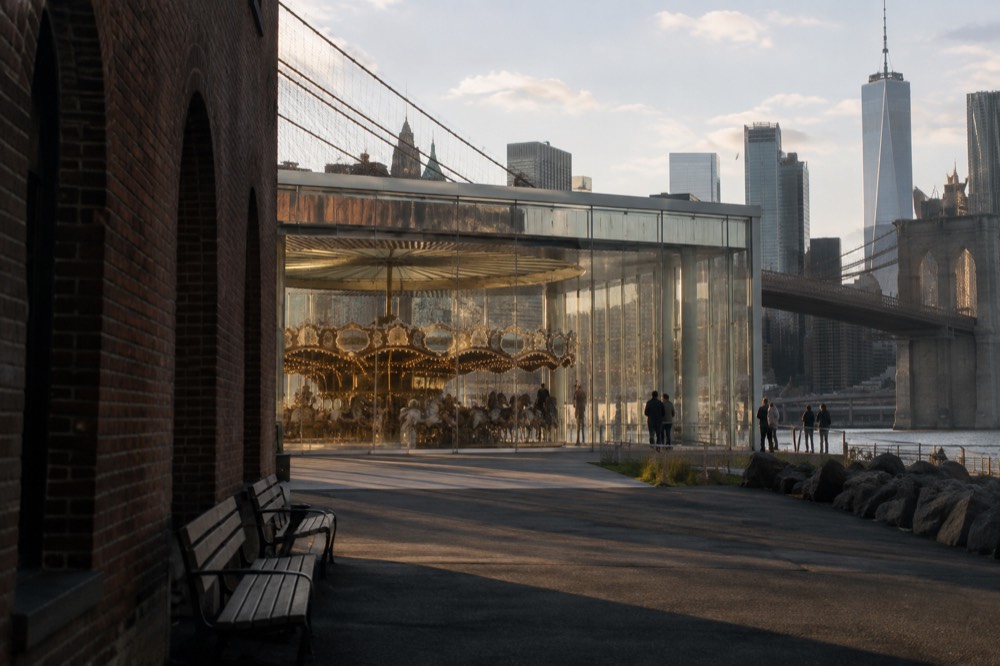
The piers of Brooklyn Bridge Park, particularly the ones around Pier 1, give the classic panorama of Lower Manhattan, One WTC included, and they are the place for a skyline shot that includes the East River itself. Jane's Carousel, with its glass walls, is photogenic from outside even if you never ride it.
A few practical notes. The cobblestones are genuinely uneven; whatever the season, wear shoes with real soles. And if your whole day in New York is built around views, it is worth reading this site's roundup of the best views in NYC and planning which ones you want from the ground versus from a deck. This overview of things to do in NYC is the place to slot Dumbo into a bigger itinerary.
When Is the Best Time of Day to Visit Dumbo?
Early morning is the best time, without much competition: between 8am and 10am the light is good, the Washington Street intersection is passable, the bridge promenade is walkable, and the parks are quiet. By 11am on any weekend the photo spots fill, and from noon onward the area runs at full visitor capacity through sunset. Weekday afternoons split the difference, and winter weekdays are the quiet version of the neighborhood, cold but nearly empty at the famous corners.
The pattern is predictable because the crowd is a pipeline: people walk across the Brooklyn Bridge through the morning, arrive in Dumbo, shoot Washington Street, eat, and disperse into the park. The earlier you cross the bridge, the more of the pipeline you are ahead of.
Sunset is the second-best window, but for the opposite reason: it is not quiet, it is golden. The skyline faces west, so the buildings catch the evening light, and the walk back across the bridge at dusk with the city lighting up is one of New York's reliable free pleasures. The trade is crowds on the promenade, which narrows in places.
Season matters less than you would think. July is actually New York's wettest month by the official climate normals, 4.60 inches of rain on average, ahead of August and June, so summer visitors should hold a rain plan more seriously than winter visitors, for whom February, the snowiest month at 10.1 inches on average, is the risk. Either way, the neighborhood is compact enough that a weather pivot is easy: Time Out Market and the shops are indoors.
What and Where Should You Eat in Dumbo?
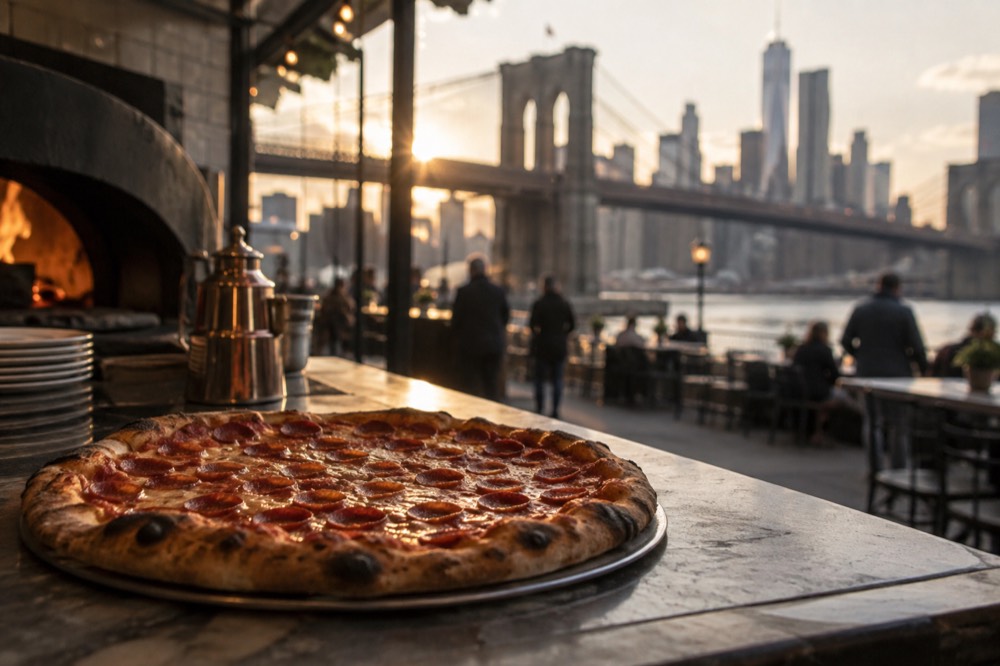
Dumbo's eating runs from huge and easy to specific and queue-worthy. Time Out Market, a food hall with a rooftop skyline view, is the default for groups and picky eaters. Juliana's and Grimaldi's, two of Brooklyn's best-known coal-oven pizzerias, sit blocks apart near the Old Fulton Street corner. Add a longtime chocolatier for hot chocolate and a cluster of coffee roasters, and the neighborhood eats well above its size.
The pizza question deserves a straight answer, because it is the neighborhood's most argued one. Juliana's and Grimaldi's are both classic New York coal-oven pizzerias, both a short walk from the bridge's Brooklyn exit, and both draw lines at peak hours. Either is a legitimate answer; going at an off-peak hour, mid-afternoon on a weekday, matters more than which one you choose.
For a broader bite, the food hall model wins on flexibility. Everyone in your group picks their own thing, and the view does the rest. The market sits inside the neighborhood's main complex, so it doubles as a rainy-day base.
Sweet stops are a Dumbo specialty. The chocolatier on the main drag has been drawing people for hot chocolate since before the neighborhood was famous, and the bakery scene leans serious. If you would rather eat your way through several neighborhoods with someone else routing it, this site's NYC food tours guide compares the walking tasting tours, including the Chinatown and Little Italy circuits on the Manhattan side of the bridge.
A rough planning budget for a day of eating in Dumbo:
| Meal or stop | Typical spend per person | Notes |
|---|---|---|
| Coffee and a pastry | $8-$15 | Roasters and bakeries cluster on the main streets |
| Slice or personal pizza | $5-$10 | By-the-slice spots exist; sit-down pies run higher |
| Whole pie, sit-down pizzeria | $25-$45 | Split between two or three people |
| Food hall main plus a drink | $25-$40 | Time Out Market and similar halls |
| Ice cream or chocolate stop | $8-$15 | Waterfront queue at peak |
Prices shift and menus change, so treat those as planning ranges and check the counter, not as promises.
Is Dumbo a Good Place to Stay, or Just to Visit?
Dumbo suits one specific traveler: the visitor on a second or third trip who wants a quiet, scenic, walkable base with the skyline in the window and the F train minutes away. For a first-timer racing the major sights it is the wrong base: hotel supply is thin, prices run high, and the local F ride from York Street adds time to every Manhattan day compared with Midtown or Downtown lodging.
The case for staying is atmosphere. Mornings and evenings, when the day-trippers are absent, the neighborhood is calm and genuinely beautiful, and the parks become local space. Restaurants and the bridge are at your door.
The case against is logistics and supply. Dumbo has far fewer hotel rooms than Midtown, the Lower East Side or Brooklyn Heights-adjacent areas, and fewer budget options still. Every sightseeing day starts with a ride under the river, and while the F train is reliable, it is a local line from York Street.
For most readers, the better pattern is to visit Dumbo on a dedicated Brooklyn day, pair it with Brooklyn Heights and maybe Williamsburg, and sleep in Manhattan or wherever the rest of the itinerary dictates. The site's where to stay in NYC guide compares the neighborhoods properly, and the things to do in Brooklyn roundup places Dumbo in its borough context.
| Dumbo as a base | Dumbo as a day stop |
|---|---|
| Best for repeat visitors who know the Manhattan hits already | Best for first-timers pairing it with the bridge walk |
| Thin hotel supply, higher prices, book well ahead | Free to slot into any day, no booking needed |
| Quiet, scenic evenings once crowds drain | Peak crowds midday, especially weekends |
| F train local ride to every Manhattan day | Arrive via bridge walk, leave via subway |
| Food hall, pizzerias and parks at the door | Same food and parks, condensed into two to four hours |
How Much Time Do You Need in Dumbo, and What Does a Visit Cost?
Two hours is the satisfying minimum, covering the Washington Street view, a park stroll and one food stop. Four to five hours covers the bridge walk in both directions, a sit-down meal and carousel time. Cost is almost entirely optional: the photo spots, the park, the beaches and the promenade are free, so a visit can cost nothing beyond a $3.00 subway fare, while pizza, the carousel and a ferry back push a couple toward $100.
The free layer is the substantial one. Washington Street, Pebble Beach, the piers, the lawns and the skyline from every bench cost nothing. The carousel charges per ride, the food costs what food costs, and the paid tours are optional add-ons rather than entry requirements.
If you want a guide rather than a map, the free-walk route is the value pick. The Financial District walk on GuruWalk, for instance, pairs Wall Street and the 9/11 Memorial on the Manhattan side, and several free walks on GuruWalk cover the Brooklyn side; a sunset version of the bridge crossing exists too, timed to the skyline turning gold. Guides work on tips, so the cost is your call. The guided walking tour of the bridge and Dumbo is the fixed-price alternative at $49 per person from, covering the engineering story and the Washington Street view with someone else handling the route.
For families, the calculus is simple: the carousel, the park lawns and the pebble beach are a genuinely kid-friendly half day, and the bridge walk is flat enough for most children. This site's things to do in NYC with kids places Dumbo high on the Brooklyn list for exactly that reason.
Can You Walk from Dumbo to Brooklyn Heights and Other Neighborhoods?
Yes, and you should: Brooklyn Heights sits immediately south along the water, connected by the Brooklyn Heights Promenade and the park's continuous waterfront path, and the whole walk from Dumbo's Main Street Park to the Promenade's classic skyline balcony takes about fifteen minutes. Beyond it, Brooklyn Bridge Park continues south toward Cobble Hill and Carroll Gardens, while north of Dumbo the waterfront path runs under the Manhattan Bridge toward Vinegar Hill, a quiet historical pocket most visitors never see.
The Heights pairing is the natural one. The Promenade sits a level above the river, so it frames the skyline differently from Dumbo's water-level views, and the neighborhood behind it is quiet brownstone blocks. A loop, bridge walk into Dumbo, park south, Promenade, back up through the Heights, is one of the best two-hour walks in New York and costs nothing.
North is the opposite experience. Vinegar Hill, on the far side of the Manhattan Bridge, is a few blocks of quiet 19th-century streets and old industry, largely untouched by the boutique wave. It is a ten-minute detour for people who like their neighborhoods calm.
Further afield, the Brooklyn attractions worth pairing with a Dumbo day are covered in the site's Brooklyn guide, and the Williamsburg guide covers the north-Brooklyn companion trip if you have a full day to spend in the borough.
What Not to Miss, and What to Skip, in Dumbo
Do not miss the Washington Street view, the bridge walk in at least one direction, Pebble Beach at water level, and a long sit on a park pier facing the skyline. Skip the carousel if the queue is long and you have no children, skip pizzeria lines at peak hours for an off-peak slot, and skip Dumbo on a weekend afternoon if your crowd tolerance is low, since the famous corners run at maximum density then.
The compressed priority list:
| Priority | What | Time needed | Cost |
|---|---|---|---|
| Essential | Washington Street view | 10 minutes | Free |
| Essential | Brooklyn Bridge promenade walk, one direction | 30-40 minutes | Free |
| Strong | Pebble Beach water-level photo | 15 minutes | Free |
| Strong | Brooklyn Bridge Park piers and lawns | 30-60 minutes | Free |
| Worthwhile | Coal-oven pizza, off-peak | 45-60 minutes | $25-$45 a pie |
| Worthwhile | Jane's Carousel | 15-30 minutes | Per-ride ticket |
| Optional | Food hall lunch | 45 minutes | $25-$40 |
| Optional | Ferry return to Manhattan | 20-30 minutes | Ferry fare |
The one mistake to avoid is treating Dumbo as a destination you drive or subway directly into at midday. The neighborhood is the ending of a walk, not the start of one. Cross the bridge first, so the skyline is in your face the whole way over, and let Dumbo be the reward.
And for the classic version of that crossing, the sunset free walk on GuruWalk ends on the Brooklyn side as the lights come on, with the guide's pay set by you at the finish. The fixed-price guided option covers the same ground with a set schedule. Either way, the view does the heavy lifting.
Common Questions About Dumbo Brooklyn
The questions below are the ones visitors actually ask about Dumbo, answered in short form. The neighborhood is small, mostly free, and at its best in the morning, and it is best reached on foot across the Brooklyn Bridge eastbound, with the skyline in front of you the whole way over. The carousel, the pizzerias and the park each get a straight answer, and the food budget gets honest ranges rather than promises.
Is Dumbo Brooklyn worth visiting?
Yes, for two to four hours on almost any itinerary. The Washington Street view, the waterfront park and the bridge walk together form one of the best free experiences in New York. It is worth less as a standalone destination you travel specifically to, and more as the Brooklyn half of a bridge crossing.
What does Dumbo stand for?
Down Under the Manhattan Bridge Overpass. The name dates from the neighborhood's industrial years, when the area was factories and empty lofts, and it stuck through the conversion into one of Brooklyn's most expensive pockets.
How do I get to Dumbo from Manhattan?
Walk across the Brooklyn Bridge eastbound, about 30 to 40 minutes at a sightseeing pace, and descend at the Brooklyn end. Alternatives: the F train to York Street, the A or C to High Street, or the ferry to the Brooklyn Bridge Park area. The subway fare is $3.00 with OMNY.
Where is the famous Dumbo photo spot?
Washington Street, looking northeast toward the Manhattan Bridge. The Empire State Building appears centered in the bridge's arch above the cobblestones. Shoot early: the intersection fills with photographers and passing cars by late morning on weekends.
Is Dumbo good for kids?
Very. Jane's Carousel, the park lawns, the pebble beach and the flat bridge walk make it one of the easiest Brooklyn days with children. The food hall solves the everyone-picks-their-own-lunch problem, and the whole circuit is short enough for small legs.
Is Dumbo expensive?
As a visit, no: the main attractions, the view, the park, the beach and the bridge, are all free. As a place to eat and shop, yes: pizza, the food hall and boutiques run at or above Manhattan prices, and hotel rooms are scarce and costly relative to Midtown.
For the wider picture of where this neighborhood fits in a first or repeat trip, New York City Travel Guide covers the boroughs, the itineraries and the ticket decisions in full.