Can You Visit the UN Headquarters in New York?
Yes, the public can visit the United Nations Headquarters in New York. Here is how tours work, what you can see without one, and what to know before you go.
Can You Visit the UN Headquarters in New York?
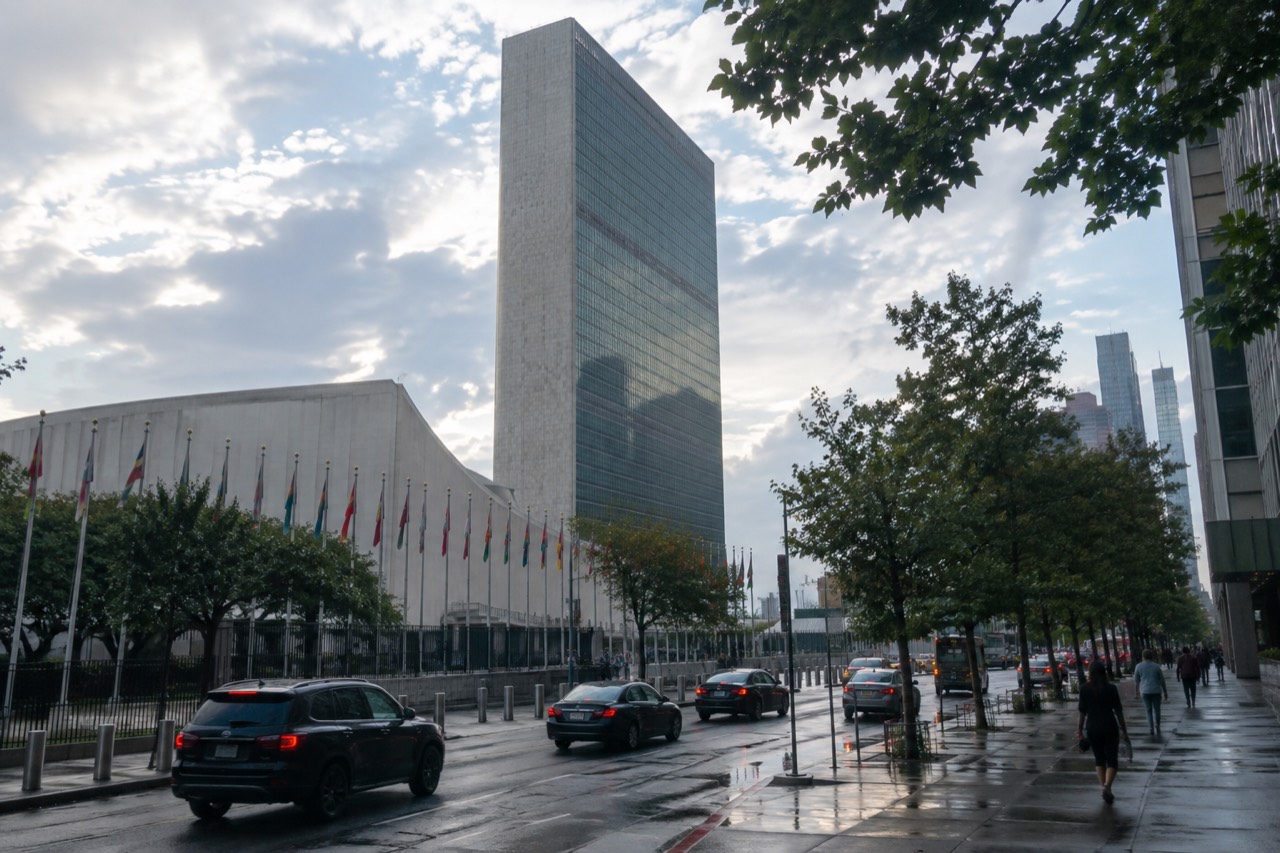
Yes, and it is easier than most people expect. The United Nations Headquarters sits on 1st Avenue along the East River, between 42nd Street and 48th Street, on a stretch of Turtle Bay that the city gave over to the organization after the Second World War. The public entrance is on 1st Avenue at 45th Street. Anyone can walk in, pass a security screening similar to an airport's, and visit the Visitor Centre. Guided tours of the building's famous chambers run on scheduled days and can be booked through the UN's own ticketing site, visit.un.org.
That last part matters. The UN is not a museum with a box office on the corner. It is a working diplomatic compound, and access follows the diplomatic calendar rather than a tourist one. When the General Assembly is in session, typically in September, the building fills with delegations and the tour routes change. Some chambers close. A visit planned around a big meeting week looks very different from a quiet Tuesday in February, and the UN's own visitor pages say which rooms are on the route before you book.
The building rewards the trip. The Secretariat tower, the curved General Assembly hall, the Conference Building over the river, and the public plaza with its member state flags in a long row form one of the most recognizable pieces of architecture on the East Side. From Midtown's hotel districts it is a short walk or one subway ride from Grand Central, which makes it an easy add-on to a day around Midtown Manhattan rather than a trip in itself. For a fuller picture of how to slot it into a visit, see our overview of things to do in NYC.
Can You Visit the UN Headquarters in New York?
Yes, the general public can visit the United Nations Headquarters in New York. The building runs guided tours that visitors book in advance through the UN's own site, and a Visitor Centre inside the complex is open to walk-ins who clear security. Tours visit chambers including the General Assembly and Security Council when the diplomatic schedule allows, and the whole experience typically takes about an hour.
The distinction to hold onto is between the Visitor Centre and the tour. The Visitor Centre, inside the public entrance on 1st Avenue, holds a small shop, a postal counter, and exhibits, and it costs nothing to enter beyond the security line. The tour is the part that takes you upstairs into the working building, and that is the part you book ahead. Walk up on a busy day hoping to join a tour on the spot and you may be turned away, because tour groups are capped and timed.
Booking is done through the UN's ticketing site rather than through a third party. That is worth knowing because the UN sets its own prices and its own rules, and the money from tickets goes toward the organization's work rather than to a reseller. Check current prices and available dates on the listing when you plan, since the UN adjusts both.
One more thing that surprises people: the headquarters site is international territory in a practical legal sense, under an agreement between the UN and the United States. You do not need a passport to enter as a visitor, but the compound does not sit under ordinary city jurisdiction, which is why the UN has its own security force and its own postal administration. The famous UN stamps, sold only at the UN and valid only when mailed from there, exist because of that arrangement.
Where Is the United Nations Headquarters and How Do You Get There?
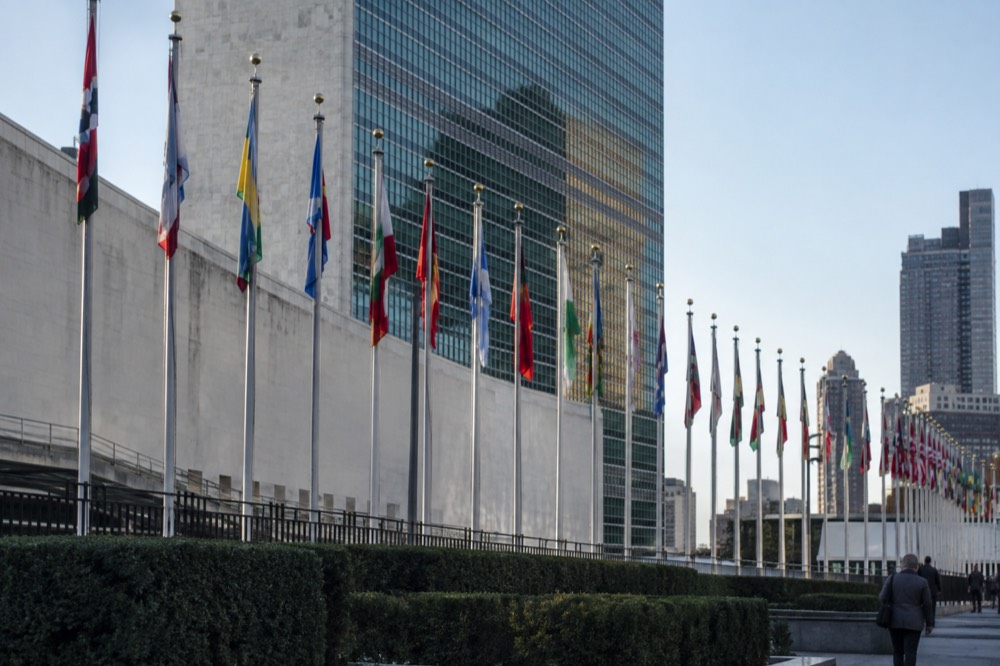
The UN Headquarters occupies the block of 1st Avenue from 42nd Street to 48th Street, on Manhattan's East Side facing the East River. The nearest subway hub is Grand Central Terminal, about a ten minute walk west, served by the 4, 5, 6 and 7 trains and the 42nd Street shuttle. The public visitor entrance is on 1st Avenue at 45th Street.
From Grand Central, the walk is simple: exit toward Lexington Avenue, walk east on 42nd Street or 45th Street until you hit 1st Avenue, and the flags are in front of you. The 4, 5 and 6 trains stop at Grand Central-42 St, and the 7 crosses from the West Side through the same station, so the complex is reachable from most of Midtown in a few minutes. The M15 bus runs along 1st Avenue if you are coming from further uptown or downtown and would rather not walk.
If you are staying in Times Square or the Theater District, take the 7 train directly, it is one stop from Times Sq-42 St to Grand Central and then the walk east. Coming from the Upper East Side, the 4, 5 or 6 to Grand Central works, or simply walk down 1st or 2nd Avenue. There is no parking worth recommending here. East Side traffic on 1st Avenue is heavy and garage rates around the UN are among the higher ones in Midtown, so the subway is the honest answer, as it usually is in this city.
The approach from the west is the one most visitors take, and it has a small advantage worth knowing. You pass through the everyday Midtown blocks around Grand Central Terminal, which are worth ten minutes of wandering in themselves, and you arrive at the plaza with the flags in a single straight line ahead of you. The view from 1st Avenue, tower behind flags, is the picture most people come home with.
What Do Guided Tours of the UN Headquarters Include?
A standard guided tour of the UN Headquarters lasts about an hour and walks visitors through the public and ceremonial spaces of the complex, including the General Assembly Hall and the Security Council Chamber when meetings permit. Guides are recruited from many countries, commentary runs in several languages, and tickets are bought in advance through the UN's own site, visit.un.org.
The General Assembly Hall is the room most visitors come for, the wide curved chamber with delegations seated in English alphabetical order by country. Whether you see it depends on the calendar. When the Assembly is sitting, the chamber is off the tour route, and in September especially the whole building shifts around the session. The Security Council Chamber, the horseshoe room where the famous resolutions are debated, is the other headline stop, and it too closes when the Council is in session.
Tours also cover the Councils and committee rooms that visitors rarely picture, the corridors of gifts given by member states, and the public art on the grounds, including the knotted revolver sculpture on the North Garden lawn and the Isaiah wall facing 1st Avenue, carved with the line about beating swords into plowshares. None of this requires deep prior knowledge. The guides are used to first-time visitors and to school groups, and the tour is pitched accordingly.
Bookings should be made early for two reasons. Tour sizes are limited, and the schedule shrinks around diplomatic events. If your dates are fixed, check availability at visit.un.org as soon as you know them, and treat a September visit as the hardest to plan, since that is the General Assembly's high session and the building is at its busiest. A visit in the quieter months gives you a better chance of seeing the chambers empty and lit for visitors.
If the UN tour is one stop in a packed sightseeing week, a pass can make the rest of the day cheaper. The New York CityPASS bundles five major attractions at a discount, and while the UN is not among them, the pass covers the heavy hitters around Midtown and downtown that pair naturally with a morning at the UN.
Since the UN sets its own ticket prices and the pass covers everything else, the honest budgeting move is to decide your deck-and-museum count first, then check whether the pass beats buying individually. You can lock in the bundle and still cancel if the itinerary changes, which makes it a low-risk way to plan the sightseeing around your UN morning.
What Can You See at the UN Without a Tour?
Visitors who skip the guided tour can still enter the complex, clear security, and use the Visitor Centre beside the public entrance, which holds a shop, a postal counter selling UN stamps, and free exhibits. The plaza and grounds along 1st Avenue, including the member state flags and the public artworks, are viewable from outside at any time without a ticket at all.
The free part is genuinely free. The flags, the Isaiah wall, the knotted gun sculpture on the lawn, and the Secretariat tower itself are all best seen from the public sidewalks of 1st Avenue and Ralph Bunche Park across the street. Photographers get most of what they want without entering. The classic shot is from the plaza looking north along the flag row with the tower behind, and morning light works in your favor because the complex faces west. Everything else covered here is indexed on New York City Travel Guide.
Inside, the Visitor Centre is the untoured visitor's territory. The postal counter is the fun part: UN stamps are real postage, but only for mail posted on the premises, so the tradition is to write a postcard there and drop it into the UN's own mailbox. The shop sells UN-related books, gifts and the member state flags in miniature. Exhibits in the public area rotate and are usually tied to the organization's campaigns, from human rights to climate.
What you cannot do without a tour is go upstairs. The General Assembly Hall and the Council chambers are inside the working building, and the escalators beyond the Visitor Centre are for ticketed groups and staff. So the honest framing is this: the outside and the Visitor Centre make a good free stop of thirty to forty minutes, while the tour is the only way inside the rooms you have seen on the news.
Is the UN Headquarters Worth Visiting on a Short Trip?
For most first-time visitors on a short trip, the UN Headquarters is a strong half-day stop rather than a full-day destination, best suited to travelers with an interest in politics, history or architecture. The tour takes about an hour, the complex sits ten minutes from Grand Central, and it pairs naturally with Midtown sights like the Chrysler Building area and the East River waterfront.
Whether it belongs on your list depends on what draws you. If your New York is skyscrapers, food and shows, the UN is skippable without much loss. If you follow world affairs, or you want the one stop in the city where the international system has a physical address, it is hard to beat. Standing in the General Assembly Hall, even empty, is a different order of experience from looking at it in photographs, and many visitors describe it as the moment the organization became concrete for them.
Families should know the tour works for children. The guides handle school groups constantly, the walking is easy, and the security screening is the only patience-test. Very young children may find an hour of chamber-walking dull, but older kids studying history or current events tend to come out talking. There are no age restrictions on the standard tour, though check the booking site for the current policy on youngest visitors and strollers.
The efficient pattern is a morning at the UN followed by the Midtown circuit. The Chrysler Building's lobby, though usually closed to the public except on limited access days, is on the walk back toward Grand Central, and from Grand Central you can continue to the Library at 5th Avenue and 42nd Street, or up to Rockefeller Center and the observation decks. That loop, UN to Grand Central to Rockefeller, is one of the best half-days on the East Side.
What Should You Know Before You Go to the UN Headquarters?
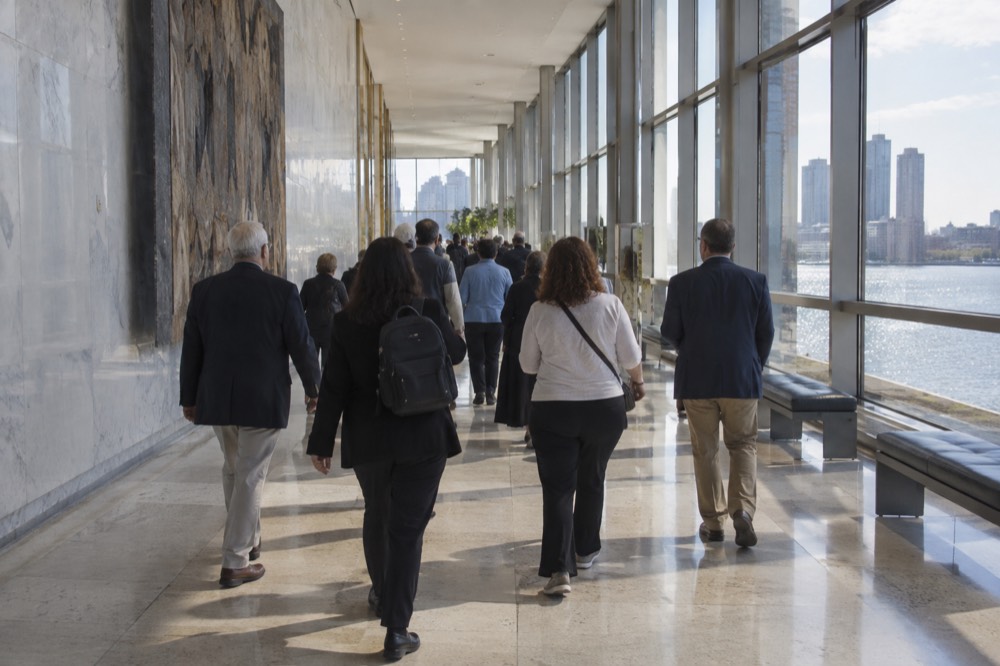
Bring government-issued photo ID, book the guided tour in advance through visit.un.org, and expect an airport-style security screening at the public entrance on 1st Avenue at 45th Street. Large bags and luggage are not permitted, the building closes on weekends for most visitor purposes, and tour routes change whenever the General Assembly or Security Council is in session.
The ID rule is real and enforced. The UN is a diplomatic site, and adults are asked for photo identification at entry. A passport or driver's licence is fine. The screening is like an airport's, shoes off, bags through the scanner, so build in ten to fifteen minutes of buffer before your tour time. Arriving late for a timed tour risks losing the slot, and tour groups do not wait.
The weekend point catches people out. The headquarters is a workplace, and the standard visitor program runs on weekdays, with Saturdays and Sundays either closed or sharply reduced depending on the season. Check the booking site for the days that apply to your visit rather than assuming a seven-day attraction. Public holidays follow the UN's own calendar, which mostly but not entirely overlaps the American one.
Dress is casual-visitor standard, nothing formal required. Photography is generally allowed in the public spaces and in the chambers when tours permit it, but always follow the guide's instruction, and some ceremonial rooms restrict it when meetings are near. The building is fully accessible, with step-free routes through the complex, and the booking site covers accessibility requests when you reserve.
Here is the practical picture in one table:
| Question | The answer for visitors |
|---|---|
| Can the public enter? | Yes, through the visitor entrance on 1st Avenue at 45th Street, after security screening |
| Is there a tour? | Yes, a guided tour of roughly an hour, booked in advance at visit.un.org |
| What does the tour see? | General Assembly Hall and Security Council Chamber, when the diplomatic schedule allows |
| Can you visit without a tour? | Yes, the Visitor Centre, shop and postal counter are open to screened walk-ins |
| What does it cost? | Tour prices are set by the UN and shown on the booking site; the Visitor Centre is free |
| What days is it open? | Weekdays primarily, with the schedule reduced on weekends, check before you go |
| What ID do you need? | Government-issued photo ID for adults |
| Biggest bags allowed? | Small bags only, no luggage, airport-style screening at entry |
One piece of local knowledge worth carrying: the neighborhood around the complex is called Turtle Bay, and it holds a cluster of diplomatic missions, consulates and the Japan Society, so the blocks east of 2nd Avenue have a quieter, more institutional feel than the rest of Midtown. If you want lunch afterward, walk west toward Lexington or 2nd Avenue, where the everyday restaurants are.
What Is Near the UN Headquarters for the Rest of Your Day?
The UN Headquarters sits at the eastern edge of Midtown, ten minutes from Grand Central Terminal and within walking distance of the Chrysler Building, the New York Public Library, Bryant Park and the East River esplanade. Most visitors pair the visit with Midtown sightseeing, and the 7 train from Grand Central returns you to Times Square in one stop, or to Hudson Yards in a few more.
The nearest big attraction cluster is west and south. Grand Central itself, with its main concourse and celestial ceiling, is the natural first stop after the UN, and the walk between them passes the Chrysler Building on 42nd Street, the most photographed tower in the city after the Empire State. From Grand Central, 5th Avenue leads to the New York Public Library and Bryant Park, then Rockefeller Center, then the Museum of Modern Art. That is a full afternoon on foot without a single subway ride.
South along the East River, the esplanade walk from the UN toward the Lower East Side and the Brooklyn Bridge is one of the city's underused waterfront paths. It is pleasant in the morning and at golden hour, and it connects the diplomatic quarter to the more crowded bridge-and-Dumbo circuit if you are up for a long walk. North, the route along the river leads toward the Upper East Side and its museum row.
If Midtown's towers are the theme of your day, the observation decks are the obvious finish. SUMMIT One Vanderbilt sits directly across from Grand Central, a few blocks from the UN, and its mirrored rooms and glass ledges are the most theatrical of the deck experiences. It is a short list of the city's best views, and the deck next to the UN's nearest station belongs on it.
For something older and chewier after the UN's glass and diplomacy, head south to Chinatown and Little Italy, where the food tours walk you through six tastings and a century of immigration history in about three hours. The contrast is the point: the UN is the world's conference room, and Mulberry Street is where the world actually moved in.
Common Questions About Visiting the UN Headquarters in New York
Most questions about visiting the UN Headquarters come down to four things: yes, the public can enter; the guided tour is booked in advance at visit.un.org; photo ID and security screening are required; and the chambers you see depend on whether the General Assembly or Security Council is meeting. The answers below cover the details visitors ask about most, from stamps to September closures.
can you visit the un headquarters in new york?
Yes. The public can visit the United Nations Headquarters at 1st Avenue and 45th Street in Manhattan. Guided tours of the General Assembly Hall and other chambers are booked in advance through visit.un.org, and a Visitor Centre inside the public entrance is open to walk-ins after security screening.
Do you need a ticket to enter the UN Headquarters?
You need a ticket for the guided tour, which takes you into the working building. You do not need one for the Visitor Centre, the shop or the postal counter, though everyone clears security screening at the public entrance on 1st Avenue at 45th Street.
Can you buy UN stamps at the headquarters?
Yes, there is a postal counter at the Visitor Centre selling UN stamps. They are genuine postage, but only for mail posted on UN premises, so the tradition is to write a postcard there and mail it from the UN's own mailbox before you leave.
Is the UN Headquarters open on weekends?
The visitor program runs primarily on weekdays, with Saturdays and Sundays closed or sharply reduced depending on the season. Check the booking site for the days that apply to your visit before you plan a weekend trip there.
Can you see the General Assembly Hall on a tour?
Usually yes, but not always. The General Assembly Hall and the Security Council Chamber are working rooms, and they close to tours when meetings are in session. September, when the General Assembly holds its high-level session, is the hardest month for chamber access. The UN's booking site shows the current tour route before you buy.
How long does a visit to the UN take?
Plan on about an hour for the guided tour, plus fifteen minutes for security screening, plus whatever time you spend in the Visitor Centre and shop. A comfortable visit with the free areas included runs about two hours, which leaves most of the day for the rest of Midtown.
A visit to the UN is one of the few New York stops where the building's purpose, not its height or its age, is the draw. Book ahead, carry ID, keep the bag small, and check the diplomatic calendar before you lock the date. Everything else around the visit, Grand Central, the decks, the downtown food blocks, arranges itself within a short walk or one subway ride.