Is It Safe to Swim in New York Harbor?
A direct, sourced answer on whether it is safe to swim in New York Harbor, where swimming is actually allowed in New York City, and the best ways to get out on the water safely.
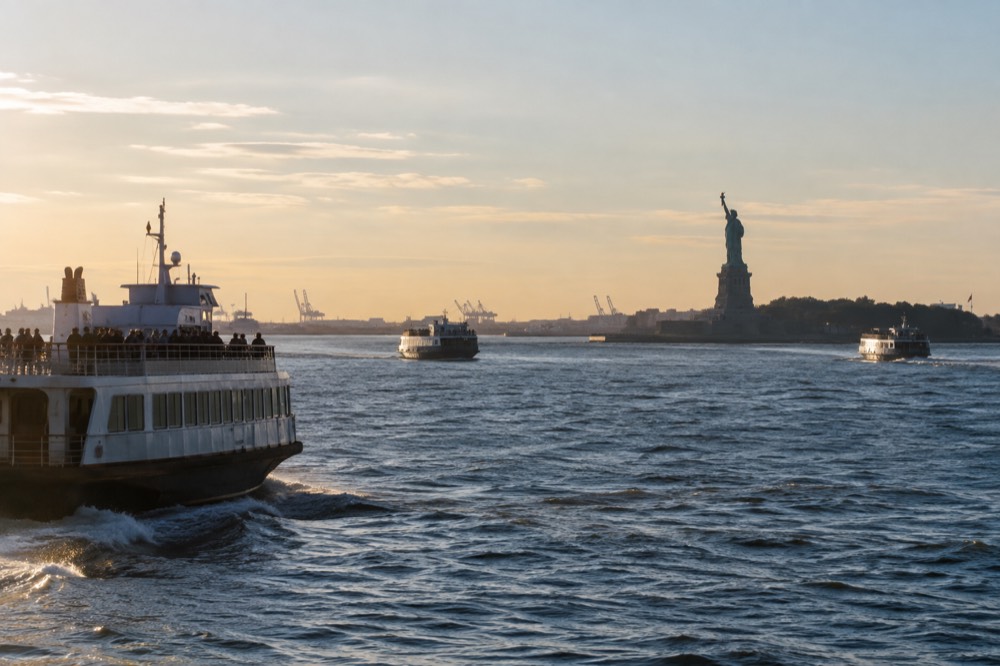
New York Harbor is one of the busiest working waterways in the United States. On any given day it carries Staten Island Ferries, sightseeing boats, water taxis, tugs pushing barges, and the occasional cruise ship, all threading through the same channels between Manhattan, Brooklyn, and Jersey City. That is the short version of why the answer to this question is no.
Is It Safe to Swim in New York Harbor?
No, it is not safe to swim in New York Harbor, and it is not permitted either. The harbor is an active commercial and ferry waterway with strong tidal currents, wakes from constant vessel traffic, and no lifeguard coverage anywhere along its shores. Swimming from piers, bulkheads, or private boats in the harbor is against city rules, and people who have entered the water there have needed rescue.
The safe way to experience the harbor is from the deck of a boat.
The harbor's currents alone rule it out. The water between the Upper Bay and the rivers is pushed by tides that reverse direction roughly every six hours, and the channels concentrate that flow. A swimmer who enters near a pier can be carried along the bulkhead line faster than they can swim back. Add the wakes of passing ferries and tugs, which rock the water even hundreds of yards from the vessel, and the picture is clear.
Then there is the traffic. Ferry routes cross the harbor on fixed schedules all day, and a swimmer in the water is nearly invisible from the wheelhouse of a boat, especially at dawn, dusk, or in chop. The operators of those vessels do not expect people in the water outside designated areas, which is exactly why designated areas exist.
Finally, the legal side. New York City does not permit swimming from its piers, seawalls, or waterfront parks, and the harbor is not a designated swimming beach. If you want to get out on the water, a harbor cruise in NYC does it properly, with rails instead of currents. The full things to do in NYC list on this site keeps the water-based options in one place.
Where Is Swimming Actually Allowed in New York City?
Swimming in New York City is allowed at designated public beaches and at the city's public pools, and essentially nowhere else. The city operates more than a dozen beaches, including Coney Island in Brooklyn and the Rockaways in Queens, which are lifeguarded daily during the summer beach season, plus a network of free outdoor pools in every borough. Rivers, the harbor, and piers are not swimming venues.
The beaches are the real answer to this question. Coney Island, Brighton Beach, Manhattan Beach, Jacob Riis Park, and the Rockaway beaches in Queens are all served by lifeguards during the season, with marked swimming areas and posted water quality advisories. When lifeguards are off duty, swimming is not allowed, and the rule is enforced rather than ignored. The city's parks department publishes beach status and any closures on its official beaches page, which is worth a check before you travel out.
The pools matter too, because they open the option to everyone. New York City runs free outdoor pools across the five boroughs, open through the summer, and they are the dependable choice on a hot day when a trip to the coast does not fit the itinerary. No ticket, no booking, just arrive within the posted hours. Some of the larger pool complexes are genuine destinations in their own right, and on the hottest July afternoons the queue can stretch down the block, so going early in the session is the local move.
One seasonal note worth planning around: the beach season has defined start and end dates each year, and outside that window there are no lifeguards at all, even on warm days. A beach in May or late September may look inviting and still be closed to swimming. The parks department page above carries the current season dates.
Here is how the main options compare:
| Where | Swimming allowed? | Lifeguards | Notes |
|---|---|---|---|
| New York Harbor (Upper Bay) | No | No | Working waterway, ferry traffic, strong currents |
| Hudson and East Rivers | No | No | Tidal currents, no designated swim areas |
| Coney Island Beach, Brooklyn | Yes, in season | Yes, daily in season | Marked swim zones, easy subway ride |
| Rockaway Beaches, Queens | Yes, in season | Yes, daily in season | Surf beach, check posted conditions |
| NYC public outdoor pools | Yes | Yes | Free, summer season, posted hours |
For visitors, the practical takeaway is simple. If the goal is a beach day, Coney Island is the classic and the easiest to reach by subway. If the goal is the harbor, stay on a boat.
Why the Rivers and the Harbor Are Not Swimming Water
New York's rivers and harbor are tidal, busy, and unguarded, which makes them unsuitable for swimming under any conditions. The East River and the Hudson are not rivers in the lazy sense: they are saltwater straits where the tide runs hard enough that even strong swimmers cannot hold position against it. Swimming there is prohibited, and the prohibition exists because people have drowned there, not because of paperwork.
The tidal point deserves emphasis because it surprises visitors. The "East River" is a tidal strait connecting Long Island Sound to the harbor, and the Hudson below the locks is an estuary, with salt water and a tide that runs both ways. The water moves through these channels at speeds a swimmer cannot counter, and the direction reverses without warning to anyone unfamiliar with the cycle. Around piers and bridge abutments the flow gets more complicated still, with eddies and drawdowns that pull a swimmer toward the structure rather than along with the current.
Water quality is the second reason, and the honest answer is that it varies. Urban runoff after heavy rain is the main driver, which is why beach advisories tend to cluster after storms. The harbor's water is far cleaner than it was in decades past, and the harbor now supports marine life that once vanished from it, but cleaner is not the same as swimmable, and no agency treats these waters as swimming water. The distinction matters: a body of water can be healthy for fish and still be wrong for a person, because the hazards that rule out swimming here are physical, not chemical.
The third reason is traffic, which we covered above, but it is worth repeating in the river context: the Hudson and East Rivers carry ferries, tugs, and recreational boats on regular routes, and the vessel mix does not pause for anyone. A swimmer is a small, low target in a big channel, and the channel is never empty.
What About Organized Swims and Triathlons?
Yes, organized events do swim in New York waters, but only under permits, with safety crews, course marshals, and water quality testing in place, which proves the rule rather than breaking it. When a triathlon swims in the Hudson, the course is closed to traffic, monitored by rescue boats, and timed to the tide. None of that protection exists for a person who jumps in on their own.
Event organizers spend months coordinating with city and state agencies before anyone enters the water. They close the course to other vessels, station kayaks and motorized rescue craft along the route, test the water ahead of the date, and schedule the swim with the tidal current rather than against it. Swimmers wear bright caps and numbered markings so marshals can count every head, and the whole operation is planned around the tide tables weeks in advance.
The lesson to take from those events is not that the water is fine. It is that the water is only fine under supervision, which is the same standard that applies at a beach with lifeguards. If you are a competitive swimmer visiting New York and tempted by an open-water route you have seen on a map, resist it. Train at a pool, or enter a sanctioned event with a bib number.
For everyone else, the sanctioned ways to get into New York water are the beaches and pools above. For everything else, the harbor is for boats.
How to Experience the Harbor Without Swimming in It
The best ways to experience New York Harbor are on the water, in a vessel: sightseeing cruises, the official Statue of Liberty ferry, and the free Staten Island Ferry all put you in the middle of the harbor with none of the risk. A full-island cruise takes in the harbor, the bridges, and the skyline in one loop. The Staten Island Ferry crosses the harbor's mouth and costs nothing.
The Staten Island Ferry deserves its reputation. It crosses the Upper Bay between Whitehall Terminal in Lower Manhattan and St. George Terminal roughly every half hour around the clock, passes the Statue of Liberty at a distance, and charges no fare. You can read more in our Staten Island Ferry guide. It is a working commuter boat, which is part of the charm: you ride with New Yorkers, not just with tourists.
If you want the statue up close, the official ferry is the only operator authorized to land on Liberty Island, and a reserved-ferry guided tour covers both islands with a guide attached. The 50-minute express cruises are the choice when you want the harbor and the skyline without giving up half a day, and the full Manhattan island loop is the choice when you do have the time. Each of these puts you where the views are, with a rail to lean on and a crew whose job is the water.
A quick comparison of the harbor options:
| Experience | Time | What you get | Best for |
|---|---|---|---|
| Staten Island Ferry | About 25 min each way | Free harbor crossing, statue at a distance | Budget views, zero planning |
| Express statue cruise | 50 minutes | Close-up statue pass, skyline, no landing | Photos, tight schedules |
| Full island cruise | 2 hours 30 minutes | Entire Manhattan loop, bridges, statue pass | A free afternoon |
| Official Liberty Island ferry | About 5 hours | Lands on Liberty and Ellis Islands | Museum time, island access |
The full-island cruise is the one that answers this article's question in the most satisfying way. You spend two and a half hours on the harbor, close enough to feel the spray, with the city on both sides of you, and at no point does anyone need to be in the water. Check availability if that sounds like the right pace.
Getting to the Waterfront and the Beaches
Getting to New York's swimming beaches by subway is cheap and simple: tap a card or phone with OMNY, pay $3.00 per ride, and the fare caps automatically at $35 in any seven-day period, with no pass to buy. Coney Island is a direct ride on the D, F, N or Q trains, and the Rockaways are reachable on the A train or the Rockaway Park Shuttle. The MetroCard is retired, so do not plan around one.
That fare detail matters more than it used to. As of 1 January 2026 the MTA no longer sells or refills MetroCards, and the old 7-day unlimited pass is gone with them. The replacement is automatic: tap the same card or device every ride, and once you have paid $35 in rides inside a rolling seven-day window, the rest of that period is free. There is nothing to purchase in advance, which removes a decision from your trip.
The beach trips themselves are straightforward rides. Coney Island's Stillwell Avenue terminal is the end of several lines, and the boardwalk is a short walk from the platform. The Rockaways take longer from Midtown but reward you with a surf beach and a genuinely local scene. Both are covered in the site's neighborhood guides, and both put you on sand with lifeguards, which is what the harbor cannot offer.
For the harbor trips, the departure points cluster downtown and on the West Side: Battery Park for the Liberty Island ferries, South Street Seaport and Midtown West for the sightseeing loops. All are subway-accessible, and all of them hand you a rail to lean on instead of a current to fight.
Common Questions About Swimming in New York Harbor
The short answers: no, do not swim in the harbor; yes, the city has real beaches with lifeguards; no, the rivers are not swimmable either; and yes, the ferry and cruise options are the safe way onto the water. The questions below repeat the details, with the reasons attached, so you can check any one of them without rereading the whole page.
is it safe to swim in new york harbor?
No. New York Harbor is a working waterway with ferry and commercial traffic, strong tidal currents, no lifeguards, and no legal swimming areas. Swimming from piers or off boats is prohibited. Use the designated beaches or pools instead, or see the harbor from a boat.
Can you swim anywhere in New York City?
Yes, at designated public beaches and public pools. Beaches such as Coney Island, Manhattan Beach, and the Rockaways are lifeguarded daily during the summer season, and the city runs free outdoor pools across all five boroughs. Rivers, the harbor, and piers are not swimming venues.
Is the water in New York Harbor clean?
Cleaner than its reputation, but not swimmable. The harbor has recovered enough to support marine life, and the city's beaches are monitored and posted with advisories when needed, typically after heavy rain. Cleaner water does not change the currents or the boat traffic, which are the reasons swimming is not allowed.
Do people swim in the Hudson or East River?
Only in sanctioned events, under permits, with closed courses, rescue boats, and tide timing. Those events prove the water can be swum under supervision, not that it is open to the public. Swimming in either river on your own is prohibited and genuinely dangerous.
What is the safest way to get out on New York Harbor?
Take a boat. The Staten Island Ferry crosses the harbor free of charge, the official Statue of Liberty ferry lands on the islands, express cruises run 50-minute loops, and the full Manhattan island cruise covers the whole perimeter in two and a half hours. All of them give you the harbor without the risk.
Are New York's beaches free?
Yes. The public beaches are free to enter, and the city's outdoor pools are free as well. The costs are the subway fare and whatever you spend on food, which at Coney Island is part of the point of going.
The Bottom Line on the Harbor
New York Harbor is scenery you ride on, not water you swim in, and the city has deliberately arranged it that way. The waterfront is built for ferries, cruise boats, and shoreline parks, while the swimming happens at lifeguarded beaches like Coney Island and the Rockaways. Treat the harbor as a place for decks and rails, and save the swimming for the sand where someone is watching the water.
The division is not a limitation on your trip; it is the reason the harbor works so well as an attraction. A body of water this busy, this tidal, and this central to the city's life could never double as a swimming pool, and New York never pretended it could. What the city built instead is a fleet of ways to be out in the middle of it, from a free commuter ferry to a full island loop, and every one of them is safer and more rewarding than jumping off a pier.
If you are planning the rest of your days in the city, the things to do in NYC page is the place to start, and the New York City Travel Guide homepage ties the whole site together. Book a deck, keep your feet dry, and let the lifeguards at Coney Island handle the swimming.
If the islands are what drew you to the harbor in the first place, the official ferry is the one that actually lands on them, and it is worth a look alongside the cruises above.