Washington Square Park: What a Visit Actually Involves
A marble arch, a fountain full of waders and a chess corner where hustlers have taken on strangers for decades: Washington Square Park is the Village's front room, and it costs nothing to walk into.
Short answer
Washington Square Park is a free public park at the foot of Fifth Avenue in Greenwich Village, anchored by the Washington Arch and its central fountain. It is open year-round, needs no ticket, and works best as a one-to-two-hour stop between other downtown sights rather than a destination in itself.
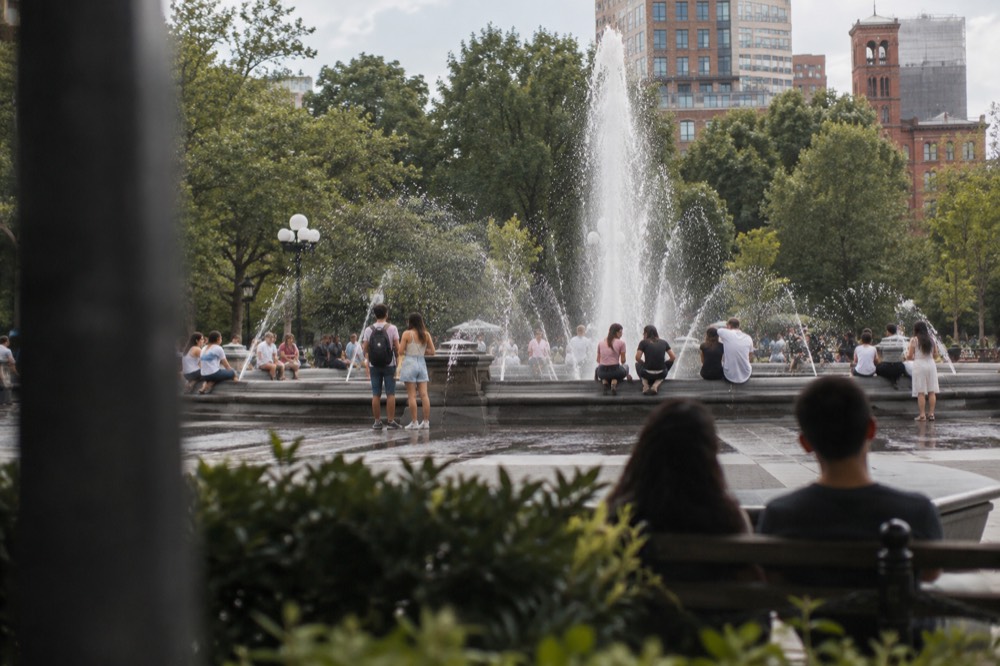
The fountain at the center of Washington Square Park has one job on a hot July afternoon: it is full of children, dogs and the occasional fully clothed tourist, and nobody stops any of them. Around the edge, a man is losing at chess, a pianist has somehow wheeled a full upright to the southeast corner, and a tour group is photographing the arch from exactly the same angle as the last tour group. This is the park's real character. It is not a monument you queue for. It is a working public square that happens to sit under one of the most photographed pieces of marble in New York.
The park sits at the foot of Fifth Avenue in Greenwich Village, surrounded almost entirely by New York University buildings. That single fact explains most of what happens inside it. The crowd skews young, the energy runs all day, and the place never fully empties. This guide covers what a visit actually involves: how to get there under the MTA's current fare system, what it costs, when to go, what to do once you are standing under the arch, and whether it earns a place on your itinerary. The short version: it is free, it is central, and an hour or two is usually enough.
What Is Washington Square Park and Why Do People Go?
Washington Square Park is a roughly ten-acre public park at the junction of Greenwich Village and NYU's campus, anchored by the Washington Arch at its northern gateway and a large central fountain. It serves as the neighborhood's main gathering space, famous for its chess players, street performers, off-leash dog culture and its history as a hub of American folk music and protest. Entry is free and no ticket of any kind is required.
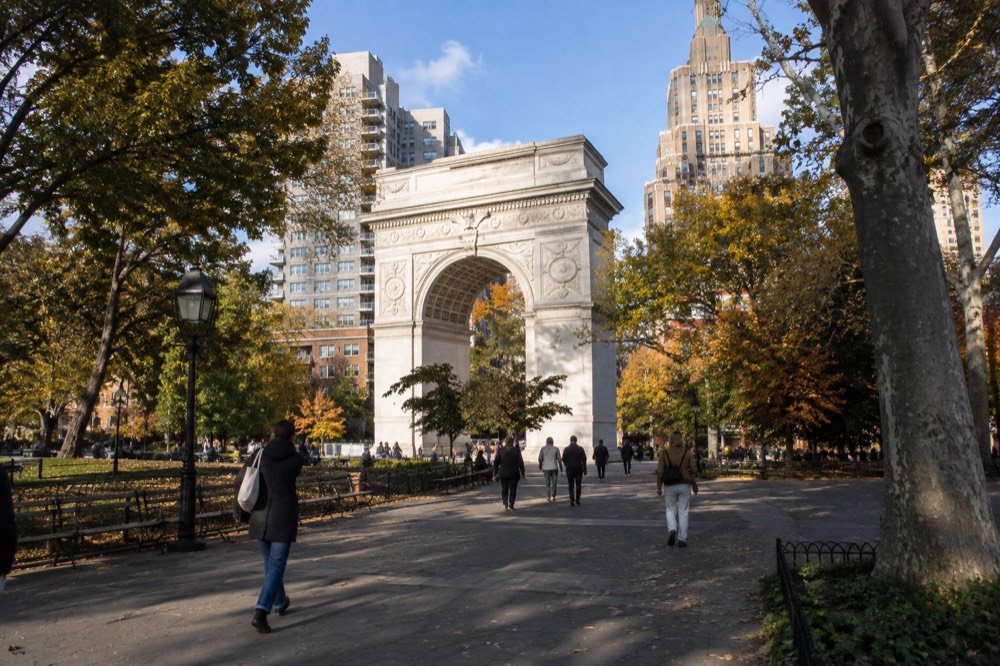
The Washington Arch is the reason most cameras come out. The marble monument honors George Washington and stands at the point where Fifth Avenue used to continue south through the square before the park closed the street off. Walking under it, south toward the fountain, is the classic approach, and the framing from the north side, with the arch's inscription readable and the fountain beyond, is the shot most visitors are trying to get.
The park's reputation rests on what happens informally. The southwest corner has long been associated with outdoor chess, and games between regulars and passing challengers are a genuine, watchable feature of daily life here rather than a staged tourist attraction. Street performers rotate through the fountain plaza: pianists, singers, dance crews and one-string instrument builders whose volume depends on the day. The dog runs on the square's sides are among the most used in Lower Manhattan, and in the early morning hours the park belongs largely to dogs and their owners before NYU's population reclaims it.
It is also a piece of American cultural history. The park and the blocks around it were central to the folk music revival that made the Village famous, and Washington Square has hosted political gatherings, vigils and celebrations for generations. You do not need to know any of that to enjoy it, but it explains the park's texture: this is a space New Yorkers have always used to be public in, not a garden designed for quiet contemplation.
For itinerary planning, the park's value is its location. It sits at the crossroads of Greenwich Village, SoHo, the East Village and NoHo, which makes it a natural midpoint on almost any downtown walking day. The Greenwich Village neighborhood guide covers the streets around it in depth.
How Do You Get to Washington Square Park?
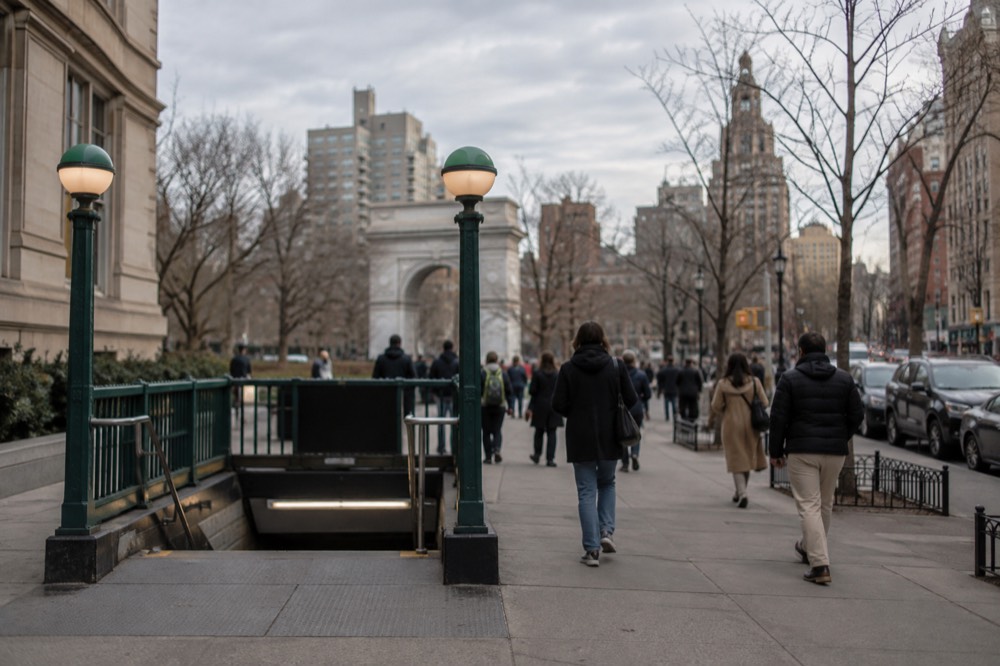
Washington Square Park sits at the foot of Fifth Avenue in Greenwich Village, bounded by Waverly Place, University Place, West 4th Street and MacDougal Street. The W 4th St subway station, served by the A, C, E, B, D, F and M trains, sits a block away, and the 8th St NYU station on the R and W is a short walk east. A subway ride costs $3.00.
The W 4th St approach is the one most visitors take, and it drops you at the park's southwest corner. The Astor Pl station on the 6 train is also close, roughly two blocks northeast, which matters if you are arriving from the Upper East Side or Grand Central without changing trains. Because the park has four entrances and no fences to speak of, there is no wrong way in; the only real decision is whether you want your first view to be the arch, which means entering from the south or west and walking north.
One transit fact matters here because it trips up returning visitors. The MetroCard is retired: as of 1 January 2026 the MTA no longer sells or refills them, and the old 7-day unlimited pass no longer exists. The replacement is automatic. Tap a contactless credit or debit card, a phone or an OMNY card at the turnstile, and the MTA caps your subway and local bus spending at $35 across any rolling seven-day window, per the MTA's fare page. There is nothing to buy in advance and no pass to activate.
If you are walking, the park is about fifteen minutes south of Union Square, ten minutes east of the Hudson River waterfront, and twenty minutes north of SoHo's shopping blocks, which makes it an easy stitching point on a downtown route. Citi Bike docks sit on the streets around the square for riders arriving on the Hudson River Greenway, one of the pleasantest approaches in the city on a fine afternoon.
Getting there from your hotel, in practice:
| Starting point | Typical approach | Notes |
|---|---|---|
| Times Square / Midtown | Any train to W 4th St (A, C, E, B, D, F, M) | Roughly 20-25 minutes door to park |
| Upper East Side | 6 train to Astor Pl | No transfer, short walk from the station |
| Brooklyn (Williamsburg) | L to 6th Av, walk south, or transfer toward W 4th St | The L's 6th Av station is about a 15-minute walk |
| Lower Manhattan | A, C, E uptown one stop to W 4th St | Quick hop from the Financial District |
| On foot from SoHo | East along W Houston or Prince Street, then south | 15-20 minutes through the shopping blocks |
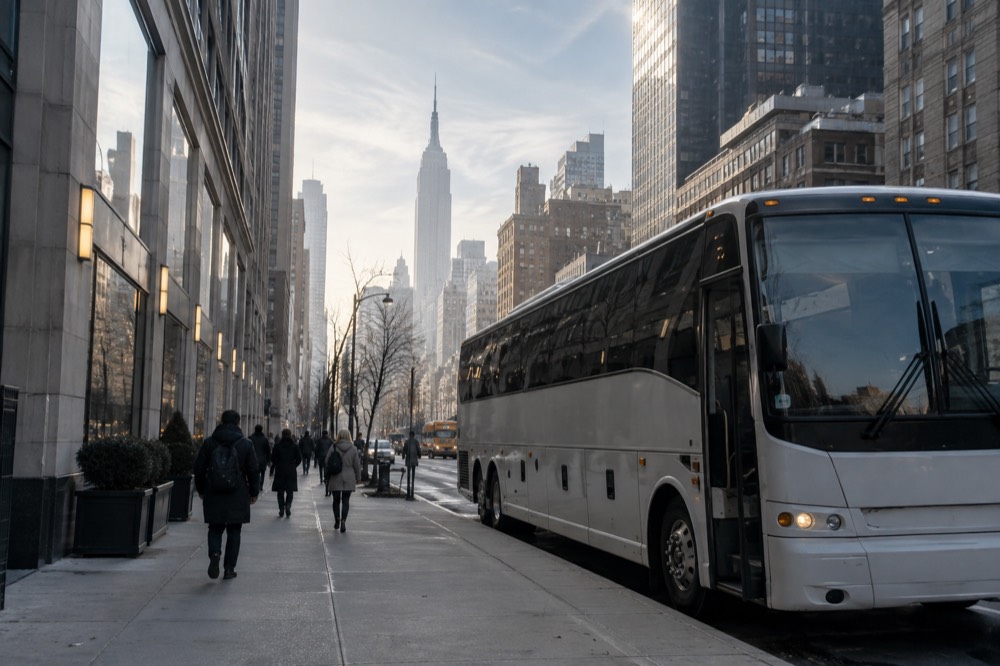
If your New York itinerary is long enough that you are also planning time out of the city, the park's location near Midtown departure points for day-trip coaches is worth knowing: most guided day tours leave from around the Port Authority and Grand Central area, so a morning in the Village pairs naturally with a following-day excursion.
How Much Does It Cost to Visit Washington Square Park?
Nothing. Washington Square Park is a public park with no gate, no ticket booth and no entry charge of any kind, and it is open year-round. The only costs associated with a visit are optional: a $3.00 subway fare each way, whatever you spend at the cafes and food vendors around the square, and tips if you enjoy a street performer or sit down for a chess game. There is no timed entry and nothing to reserve.
This puts the park in the same free category as the Brooklyn Bridge promenade, the Staten Island Ferry terminal's views and the High Line, and it is one of the reasons downtown walking days are the cheapest way to see New York well. The park does not sell anything itself. What surrounds it does: MacDougal Street and Bleecker Street to the south and west are dense with coffee shops, slice joints and old Village institutions, and the blocks east toward University Place have NYU-priced casual food. A reasonable budget for a park stop with lunch nearby is a coffee and a slice, or a sit-down lunch a block off the square.
| Item | Cost | Notes |
|---|---|---|
| Park entry | Free | No ticket, no reservation, open daily |
| Subway each way | $3.00 | Capped at $35 per rolling 7 days on one card or device |
| Coffee nearby | Typical Village cafe prices | Dozens of options within two blocks |
| Chess game | Tip-based | Bring small bills if you want to play the regulars |
| Buskers | Tip if you stay and watch | Performers rotate through the fountain plaza |
The cost question usually hides a different question, which is whether the park justifies the travel time from a Midtown hotel. On a pure money basis it is the cheapest major sight in the city. On a time basis, the honest answer is that the park rewards being folded into a Greenwich Village or downtown walking route rather than visited as a lone destination. For a fuller menu of no-cost sights, the free things to do in NYC guide collects the city's best, and the park belongs on that list.
When Is the Best Time to Visit Washington Square Park?
Mid-morning on a weekday is the calmest window: the park is open but the student crowd is in class, the chess corner is setting up, and the fountain plaza is passable without weaving. Weekends and warm evenings are the liveliest and the most crowded, with performers out in force. Winter mornings are quietest of all, and the park never closes for the season, so the choice is between atmosphere and elbow room rather than between open and shut.
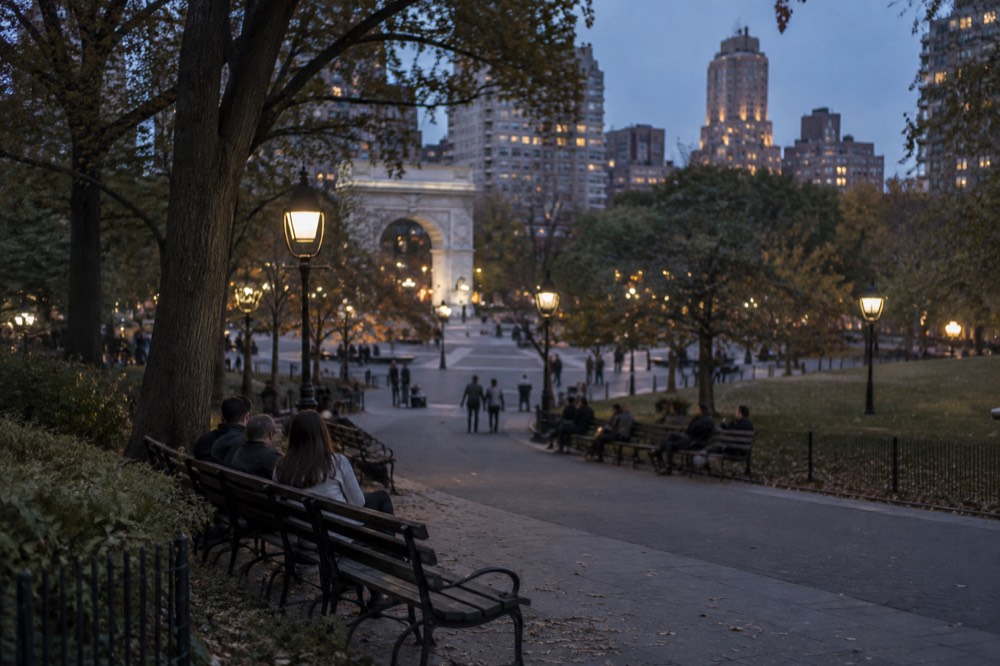
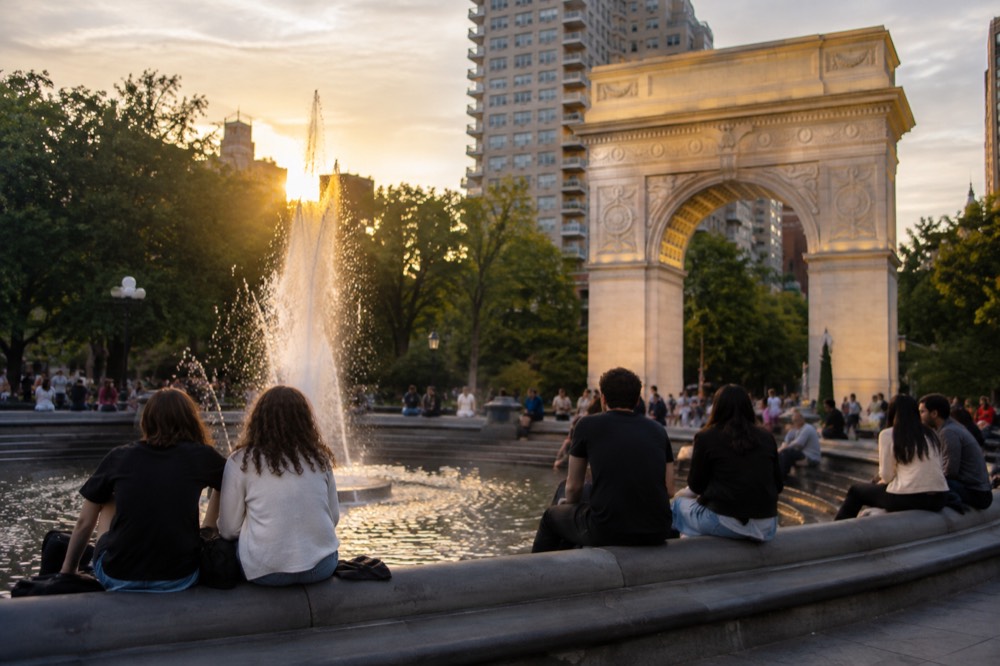
The park runs on a daily rhythm set by NYU's schedule. Early morning belongs to dog walkers and joggers. By late morning the benches fill, the chess players arrive, and the first performers set up near the fountain. Afternoon is peak: tour groups photograph the arch, students colonize the lawn edges, and the whole square hums. Evening, especially in summer, turns the fountain plaza into an informal amphitheater, and the surrounding streets stay busy well past dark because the Village's bars and music venues are a block or two south.
Seasonally, there is no bad time so much as different times. Spring and early fall give the best mix of greenery and comfortable walking weather. Summer afternoons are hot but deliver the full carnival: the fountain in use, performers everywhere, the park at maximum volume. The climate data for Central Park, which holds broadly for the city, says July is actually New York's wettest month at 4.60 inches of rain on average, so a summer visit carries a real chance of a downpour, though the park drains and recovers quickly. Winter strips the trees and thins the crowd dramatically; a snow-dusted Washington Arch with nobody in the frame is one of the city's better free photographs.
| Time of visit | Crowd level | What you get |
|---|---|---|
| Weekday, 8-11am | Low | Quiet paths, dog runs in action, easy arch photos |
| Weekday afternoon | Medium | Chess games running, some performers |
| Weekend midday-afternoon | High | Full performance scene, biggest crowds |
| Summer evening | High | Fountain full, music, festival atmosphere |
| Winter morning | Low | Bare trees, quiet, snow photos after storms |
What Should You Actually Do in Washington Square Park?
The core loop takes most visitors under an hour: enter from the south or west, walk north past the fountain to the Washington Arch, photograph it, then circle the perimeter to find the chess players, the dog runs and whatever performer has claimed the plaza. Add time if you want to sit, snack or watch a game. There is no paid attraction inside the park itself; everything worth doing is free and unfolds around you.
Start with the arch, because it is the anchor. The marble structure frames Fifth Avenue's southern terminus, and the view north through it, up the avenue toward the Empire State Building's midtown bulk, is the park's signature sightline. Photographers get the cleanest frames in morning light, before the arch's north face goes into shade and the foot traffic thickens.
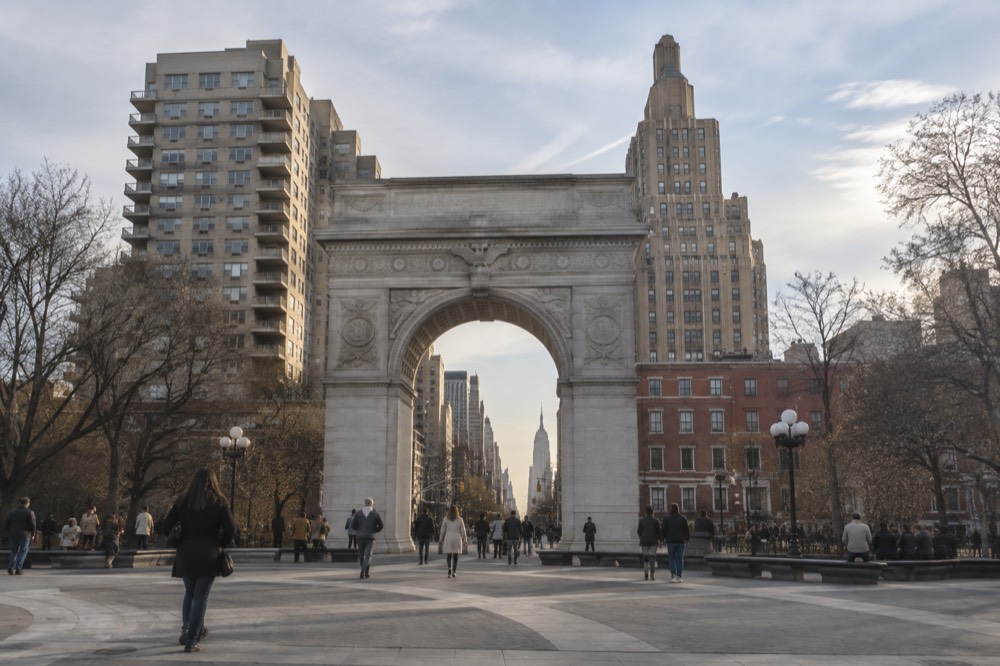
From the arch, walk south toward the fountain plaza. The central fountain is the park's stage and its cooling system in one; on summer days it functions as a public splash pad, and watching the mix of toddlers, students and visitors wade in is itself a small lesson in how New York's public space works. Performers set up around the plaza's edges, and quality varies from the indifferent to the genuinely remarkable. Staying for one full act, and tipping if you do, is the local etiquette.
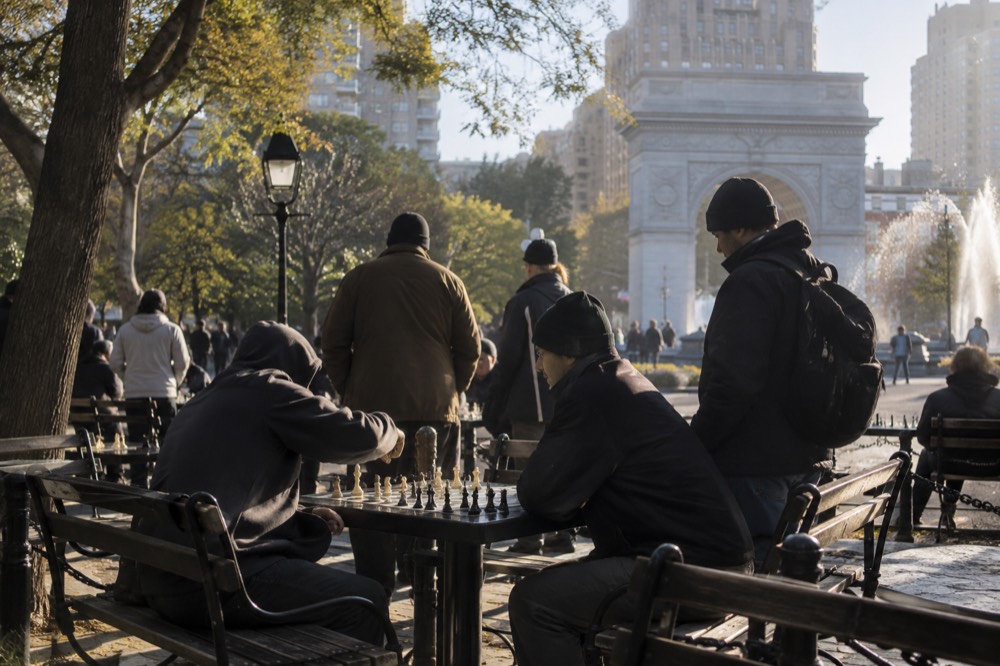
The chess corner is the park's institution. The stone tables in the southwest quadrant draw regulars who play fast, talk trash in several languages and will happily take on visitors, usually with a small stake or a tip involved. Watching costs nothing and is half the entertainment; playing costs whatever you agree to before the first move. This tradition is real and decades old, not a tourist mock-up, and it is the thing many visitors remember longest.
Beyond that, the park rewards low ambitions. Sit on a bench with a coffee from Bleecker Street and watch the square's traffic. Walk the perimeter past the dog runs, where the early-morning off-leash hours produce some of the city's best free chaos. If you have planned a food stop, the Village around the park is one of New York's best eating neighborhoods, and a guided option like this one strings the neighborhood's food institutions together:
Is Washington Square Park Worth Visiting?
For most first-time visitors, yes, as part of a downtown day rather than as a standalone trip. The park is free, central, genuinely alive in a way staged attractions are not, and it delivers the arch, the fountain and the chess corner inside an hour. Travelers with only one or two days in the city, or those indifferent to street life, can skip it without guilt and spend the time at a museum instead.
The honest case against is about scale and priority. The park is small. If your New York visit is short and your list is heavy with ticketed heavyweights, the Empire State Building, the Met, the Statue of Liberty, an hour in a Village square may feel like time you could have spent elsewhere. And on a cold Tuesday in February, with the fountain dry and the benches empty, the park presents a quieter, less impressive face than the one in the photos.
The honest case for is that the park is one of the few places where you see New York being itself at no cost and with no filter. No ticket separates you from the scene, nothing is performed specifically for tourists, and the mix of students, locals, players and visitors is the actual city. First-timers building a downtown day usually find that Greenwich Village, SoHo and the park together fill a morning more pleasantly than any single paid attraction would.
| Traveler type | Worth it? | Why |
|---|---|---|
| First visit, 4+ days | Yes | Easy add-on to a Village or downtown walking day |
| First visit, 1-2 days | Optional | Only if downtown is already on the route |
| Repeat visitor | Yes | The park changes with every visit and every season |
| Photographers | Yes | The arch sightline and street scenes reward patience |
| With kids | Yes | Fountain splash time in summer, open space to run |
| Crowds-averse travelers | Pick your hour | Early weekday mornings are genuinely quiet |
If you are assembling the fuller downtown itinerary, the master list at things to do in NYC places the park in context against every other stop you are weighing.
Can You Pair the Park with a Longer New York Base?
A downtown base around Washington Square Park pairs well with long-stay plans that include day trips, because most guided excursions to Washington DC, Philadelphia and the Hudson Valley depart from Midtown hubs a short subway ride north. A visitor spending five or more days in the city can comfortably spend mornings downtown and give one full day to a second city, with the coach handling the driving, the itinerary and the timing.
This is the planning pattern worth naming. The park, Greenwich Village and SoHo fill flexible half-days well; they are walkable, free-form and need no bookings. Day trips are the opposite: they are booked, early and long. Combining the two works when your stay is long enough that a 15-hour outing does not cannibalize your only Manhattan days. The full Washington and Philadelphia option packs the National Mall and Independence Hall into a single guided loop out of Manhattan, while the shorter DC highlights trip trades Philadelphia for a tighter Washington day. Both suit travelers who want a second city without renting a car or learning two rail systems.
For day-trip planning in general, including trains and seasonal options north of the city, the day trips from NYC guide lays out the realistic choices with travel times.
A practical word on timing if you go: these are genuinely long days, and the coach departure points sit in Midtown, so a downtown base means an early subway ride to get there. Build the day-trip day and the Village day separately, and do not schedule a theater evening after any excursion that runs past dinnertime.
Where Does the Park Fit in a Downtown Day?
The most natural downtown route runs south to north or north to south through SoHo, the Village and the park, roughly two hours of easy walking plus stops. Pair the park with a SoHo morning or a West Village lunch, then continue east to the East Village or north to Union Square. Reverse the direction for an afternoon finish under the arch in golden light, which is when the park photographs best.
Two proven shapes work. The first: start in SoHo around 10am when the shops open, walk east-to-west through the cast-iron blocks, then south to the park for a midday pause, then lunch on Bleecker or MacDougal, then either Washington Square's quieter afternoon or a walk to the West Village waterfront. The second: begin at the park in the morning when it is calm, work north through the Village to Union Square and its greenmarket, and spend the afternoon in NoHo or the East Village.
| Downtown day shape | Morning | Midday | Afternoon |
|---|---|---|---|
| Shopping-first | SoHo blocks | Park and lunch in the Village | West Village and Hudson waterfront |
| Park-first | Washington Square at opening | Union Square greenmarket | NoHo and the East Village |
| Photo-focused | Arch in morning light | SoHo architecture | Return for sunset at the arch |
| Rainy-day version | Park quickly between showers | Long lunch, cafes, bookshops | Indoor stops in the Village |
The rainy-day row deserves a note. The Village handles rain better than most of the city because its small blocks are dense with cafes, bookshops and bars, and the park itself is still walkable in drizzle if you accept a wet bench. On genuinely heavy days, cut the park to fifteen minutes between the arch and the fountain and spend the rest of the time indoors; the rainy day activities in NYC guide has the full toolkit.
Common Questions About Washington Square Park
The questions visitors ask most concern access, cost, safety, timing and photography, and the answers are mostly simple: the park is free, open daily, reachable by seven subway lines, safe by normal big-city standards at reasonable hours, and at its photographic best in the morning or at golden hour. The details below cover each of these with the specifics that matter for planning a stop.
Is Washington Square Park free?
Yes, completely. The park is public space with no entry charge, no ticket booth and no reservation system. Your only costs are transport, food and tips. It is one of the notable free sights in a city where the major attractions are mostly ticketed.
What time does Washington Square Park open?
The park is a public square rather than a gated attraction, so there is no opening time or turnstile in the ordinary sense; it is accessible around the clock, though the realistic visitor window is daytime through mid-evening. Early mornings belong to dog walkers and joggers, and the park's social life runs from late morning until the Village's evening takes over.
Which subway goes to Washington Square Park?
The W 4th St station, one block from the park's southwest corner, is served by the A, C, E, B, D, F and M trains. The 8th St NYU station on the R and W and the Astor Pl station on the 6 are both short walks away. A ride costs $3.00, with automatic fare capping at $35 per rolling seven-day period when you tap the same card or device.
Is Washington Square Park safe?
Yes, by normal urban standards, during the hours most visitors are there. The park sits in a dense, heavily walked part of Greenwich Village surrounded by a university campus, and it is busy from morning through evening. As anywhere in New York, keep your phone and bag in hand rather than on a bench, and the usual big-city attention is all that is required. The NYC safety guide covers the citywide picture with sourced figures.
Can you play chess at Washington Square Park?
Yes. The stone chess tables in the park's southwest quadrant are a decades-old institution, and the regulars will generally take on visitors, usually for a small stake or a tip agreed before the game. Watching is free and is genuinely entertaining even if you never sit down. Bring small bills if you intend to play.
How long should you spend at Washington Square Park?
An hour to ninety minutes covers the arch, the fountain, the chess corner and a lap of the perimeter for most visitors. Add time if you plan to eat nearby, watch a full street performance, or use the park as a rest stop in the middle of a longer downtown walk. It is a pause in a route, not a half-day attraction.
One last planning note before you go: the park rewards the unhurried. Every itinerary above works, but the visits people remember are the ones where they gave the square twenty minutes of doing nothing on a bench. New York does not offer many free places where the city performs itself this openly, and this, as much as the arch, is what you are walking to. For everything else on the list, the coverage at New York City Travel Guide runs the full city, borough by borough.